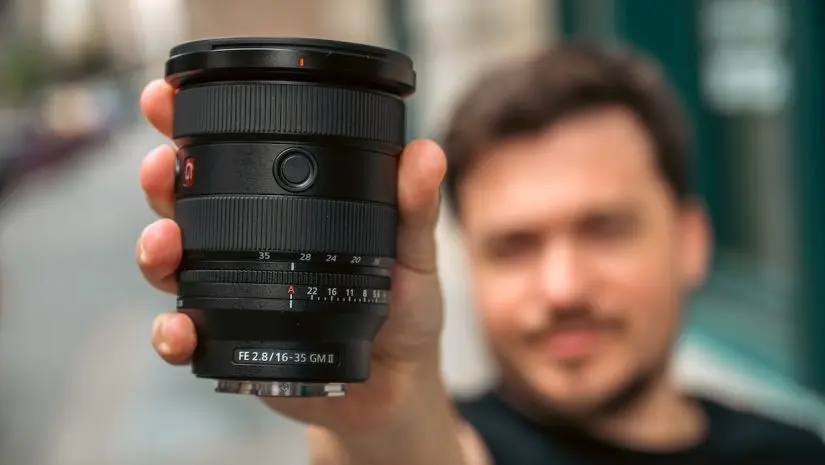
Sony FE 16-35mm f/2.8 GM II Review: Wide-Angle Workhorse Tested
The “holy trinity” of professional zoom lenses has always included the wide-angle 16-35mm, the standard 24-70mm, and the telephoto 70-200mm. For Sony E-mount users, the original 16-35mm G Master was a staple for years, but as sensor resolutions climbed toward 60 megapixels and beyond, the need for a more refined optical formula became apparent. Enter the Sony FE 16-35mm f/2.8 GM II. This second-generation lens isn’t just a minor update; it is a complete reimagining of what a professional wide-angle zoom should be, focusing on extreme weight reduction, faster autofocus, and corner-to-corner sharpness that holds up under the most rigorous professional scrutiny.
Shrinking the Footprint: Engineering for the Modern Professional
One of the most immediate impressions of the 16-35mm GM II is its physical size. Sony has managed to make this lens significantly smaller and approximately 20% lighter than its predecessor. In an era where photographers and videographers are increasingly opting for lighter kits for travel and gimbal work, this weight saving is a massive advantage. Despite the reduction in bulk, the build quality remains uncompromising. The lens is constructed with high-grade engineering plastics and magnesium alloy, resulting in a chassis that feels dense and incredibly durable.
The smaller footprint makes it a dream for landscape photographers who often hike long distances to find the perfect vista. Furthermore, the physical balance of the lens has been shifted toward the mount, which improves handling when paired with compact Alpha bodies like the A7R V or the A1. For creators who are looking for a highly portable wide-angle setup but perhaps on a different budget or sensor format, checking the sigma 16mm 1.4 price in pakistan provides an interesting perspective on how high-performance wide-angle optics have become more accessible across the board.
Optical Excellence: Resolving the Unresolvable
The optical design of the GM II is where Sony’s engineering truly shines. It features a complex arrangement of 15 elements in 12 groups, including three XA (extreme aspherical) elements. These high-precision elements are the key to the lens’s ability to resolve fine detail across the entire zoom range. During testing, the center sharpness at f/2.8 was found to be nearly identical to high-end prime lenses. Even more impressive is the corner performance; the “smearing” often seen in wide-angle zooms at 16mm is virtually eliminated here.
Chromatic aberration and flare are also exceptionally well-managed thanks to Sony’s Nano AR Coating II. Whether you are shooting an architectural interior with harsh window light or a sun-drenched landscape, the lens maintains high contrast and rich color saturation. For those who frequently switch between extreme wide-angles and distant subjects, pairing this workhorse with a dedicated telephoto lens creates a professional toolkit capable of handling everything from tight real estate interiors to expansive nature photography with no loss in quality.
Autofocus Performance: Speed and Silence
Autofocus on the 16-35mm GM II is powered by four XD (extreme dynamic) Linear Motors. This quad-motor system is necessary to move the heavy optical groups with the speed required for modern 30fps and 120fps burst shooting. In real-world testing, the focus acquisition was nearly instantaneous and, perhaps more importantly, completely silent. This makes it an ideal choice for event photographers who need to remain inconspicuous during quiet ceremonies.
The tracking performance is also a step above the original model. When using subject recognition on the latest Sony bodies, the lens stays glued to the subject even when they are moving quickly through the frame. For videographers, the lens exhibits minimal focus breathing, ensuring that the composition remains stable when pulling focus between a foreground subject and the background. This cinematic quality is a significant upgrade for narrative filmmakers who rely on the 16-35mm range for establishing shots and environmental storytelling.
Refined Ergonomics for Field Use
Sony has optimized the external controls of the GM II to match the “Version II” standards established by their recent 24-70mm and 70-200mm updates. The lens now features a dedicated aperture ring with a click/de-click switch, allowing for smooth iris control during video recording. There is also an aperture lock switch to prevent accidental changes when moving between locations. Two customizable focus hold buttons are provided, allowing for easy access to functions like Eye AF or AF-On regardless of the camera’s orientation.
The weather sealing has also been improved. With gaskets at every join and a fluorine coating on the front element to repel water and fingerprints, the 16-35mm GM II is built to operate in the most demanding environments across Pakistan. Whether you are shooting in a humid forest or a dusty urban landscape, the lens is designed to keep the elements out and the electronics protected. The petal-shaped hood is compact and features a new locking mechanism that prevents it from being accidentally knocked loose.
Video Capabilities and Gimbal Integration
The lightweight design of the GM II makes it a perfect companion for gimbal operators. Because the lens is shorter and the center of gravity is more stable, it requires less recalibration when zooming between 16mm and 35mm. This efficiency is vital for documentary filmmakers and wedding videographers who need to move quickly between different focal lengths without wasting time rebalancing their rigs.
The inclusion of an “Iris Lock” and the de-clickable ring further cements this lens as a video-first tool. The color rendering is neutral and matches perfectly with the rest of the G Master lineup, ensuring that footage shot on different lenses can be easily graded to a consistent look in post-production. The 16-35mm range is incredibly versatile for video, providing everything from ultra-wide establishing shots to a natural 35mm perspective for interviews and “run-and-gun” reporting.
Conclusion: The New Standard for Wide-Angle Zooms
The Sony FE 16-35mm f/2.8 GM II is a triumph of modern lens design. It manages to improve upon its predecessor in every measurable way—offering better resolution, faster autofocus, and superior ergonomics in a significantly smaller and lighter package. While it is a premium investment, its status as a “workhorse” means it is likely to be the most used lens in many professional photographers’ bags.
- Extreme resolution that satisfies high-megapixel sensors.
- Significantly lighter and more compact than the previous generation.
- Quad XD Linear Motors for lightning-fast and silent autofocus.
- Professional video features including de-clickable aperture and minimal focus breathing.
For the professional who demands the best in wide-angle performance, there is currently no better option in the E-mount ecosystem. It represents the pinnacle of Sony’s optical engineering in 2026, providing a reliable and high-performance tool that will serve as the foundation for creative work for years to come.