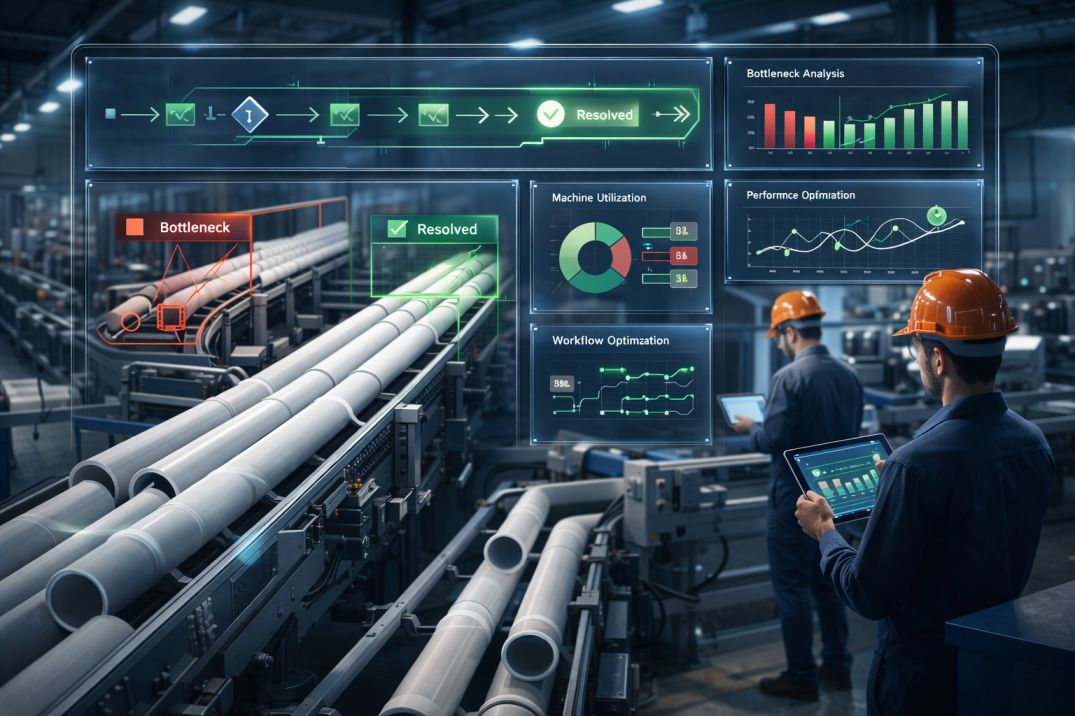
In the case of plastic pipe manufacturing, any minor disruption in the production process might lead to delayed orders, increased production costs, and, ultimately, customer dissatisfaction. Whether it is the availability of raw materials, production planning, or the lack of real-time data, production bottlenecks can significantly impact the efficiency of the production process.
This is where SAP Business One (SAP B1) can bring a revolutionary change in the production process, helping manufacturers identify, address, and eliminate production bottlenecks before they become major problems.
What Are Production Bottlenecks in Plastic Pipe Manufacturing?
A production bottleneck refers to the occurrence of a production stage that, in turn, slows down the entire production process. In the case of plastic pipe manufacturing, production bottlenecks might occur due to:
# Unavailability of raw materials like PVC, HDPE, and other raw material constituents
# Inadequate production planning and scheduling
# Downtime or inefficiency in the use of production machinery
# Inadequate utilization of human resources # Lack of real-time production data.
SAP Business One for Precision in Pipe Production:
1. Real-Time Production Visibility: One of the greatest advantages of using SAP Business One is that it offers real-time production visibility. Manufacturers can view all production processes from the issuance of raw materials to the production of finished goods. With this level of transparency:
# Production managers can quickly identify production delays
# Activities on the production floor are traceable
# Decision-making is faster and more accurate
Businesses are no longer forced to respond to problems after they happen, but can proactively resolve potential problems.
2. Smart Production Planning and Scheduling: One of the leading causes of bottlenecks is inefficient production planning and scheduling. With SAP Business One, production planning becomes easy for manufacturers. Manufacturers can create production orders based on demand and availability. The system helps:
# To prioritize urgent production orders
# To plan production orders effectively
# To balance production orders
Manufacturers can ensure smooth production by matching production schedules with demand.
3. Material Requirements Planning (MRP): One of the most common causes of production delays is the lack of raw materials. The Material Requirements Planning feature of SAP Business One helps ensure that raw materials are available when needed. MRP examines:
# Sales orders and forecasts
# Inventory levels
# Production needs
It then makes recommendations for production and procurement accordingly, thereby eliminating chances of stockouts or overstocking of inventory. Production lines are therefore never brought to a halt for lack of resources.
4. Efficient Resource Utilization: SAP Business One also helps companies make the most of their resources, such as machines and human resources, while in production. This helps companies avoid overworking some resources while leaving others idle or unused. This results in:
# Balanced production workflow
# Less idle time for resources
# More efficient production
When resources are optimally utilized, production bottlenecks are also eliminated.
5. Integration Across Departments: Another major reason for bottlenecks is the lack of integration between departments. SAP Business One integrates inventory management, production, purchase orders, and sales into one system. This ensures:
# Information flows seamlessly across departments
# Communication and collaboration happen quickly and efficiently
# Manual updates are minimized
For instance, when there is a dip in inventory levels, the purchase department is immediately informed, ensuring timely production is not affected.
6. Production Monitoring and Variance Analysis: SAP Business One also enables manufacturers to analyze their actual production performance compared to their planned production performance. This helps to identify inefficiencies such as delays, overstocking of materials, or machine downtime. With detailed reports and analytics:
# Bottlenecks can be quickly identified and addressed
# Continuous improvements can be made to the production process
This ensures a smooth and efficient production process over time.
Closing Thoughts:
As is clearly evident, SAP Business One truly streamlines production and fortifies it. Pipe manufacturers can be assured of production flowing smoothly and thus business scaling seamlessly.
Are you looking for an ERP for manufacturing? SAP Business One from SoftCore Solutions is your number one choice. With over 24+ years of SAP expertise, SoftCore Solutions ensures that the SAP B1 ERP is properly implemented to address your operational challenges. Book a live demo to see SAP Business One in action.
Frequently Asked Questions (FAQs):
1. How does SAP Business One manage raw material availability?
A. SAP Business One tracks inventory in real time and provides procurement recommendations to avoid shortages.
2. How does SAP Business One help in demand forecasting?
A. SAP Business One uses historical data and sales orders to predict future demand accurately. This is helpful for businesses as it helps eliminate the guesswork.
3. Is SAP Business One suitable for small and mid-sized manufacturers?
A. Yes. SAP Business One is ideal for SMBs in manufacturing, given it is affordable, customizable, and a scalable ERP solution.