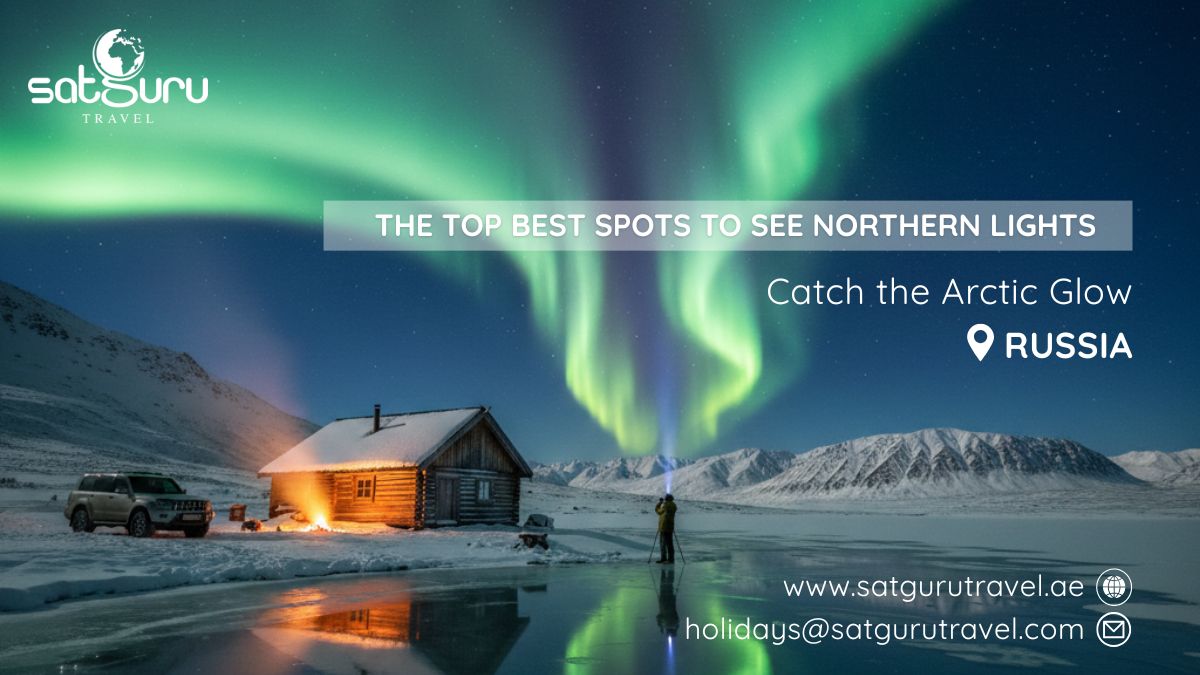
The Ultimate Guide for UAE Travelers to Hunt the Aurora Borealis
Are you dreaming of an extraordinary winter escape far from the desert heat? For travelers in the UAE, the Northern Lights in Russia offer a spectacle of nature unlike any other—often more accessible and less crowded than their Scandinavian counterparts.
Russia’s vast, northern territories, particularly those lying within the Arctic Circle, provide some of the world’s most pristine conditions for witnessing the elusive Aurora Borealis.
This expert guide will unveil the top, well-researched locations in Russia to maximize your chances of seeing the magical sky dance and help you plan the perfect trip via dedicated Russia holiday packages.
Best Time to See the Northern Lights in Russia
The Aurora Borealis is a natural phenomenon, and while luck is always a factor, timing is crucial.
- Aurora Season: The best period runs from late September to mid-April.
- Peak Viewing: For the darkest, longest nights and highest probability of clear skies, plan your trip between December and March.
- Prime Time: The lights are most frequently visible between 10:00 PM and 2:00 AM (local time).
Pro Tip: To significantly increase your odds, plan a stay of at least 3 to 6 nights in an Arctic location. This gives you multiple chances to wait for clear skies and strong solar activity.
The Science Behind the Aurora & How to Photograph the Magic
To truly appreciate the aurora on your Russia trip, it helps to understand the incredible physics at play.
What Makes the Sky Dance?
The Northern Lights (Aurora Borealis) are caused by an interaction between the Sun and Earth.
- The Solar Wind: The Sun constantly releases a stream of highly energetic, electrically charged particles (mostly electrons and protons) known as the solar wind.
- Earth’s Shield: When these particles reach Earth, most are deflected by our planet’s magnetic field (magnetosphere).
- The Collision: However, some particles are funneled down the magnetic field lines near the poles, where they slam into atoms and molecules of gases in Earth’s upper atmosphere (the ionosphere), about 100 to 300 kilometers above the ground.
- The Glow: This collision excites the atmospheric gases, causing them to emit photons—light! This process is similar to how a neon sign works.
Understanding the Colors
The color of the aurora depends on the type of gas being hit and its altitude:
- Green: The most common color, produced by Oxygen atoms at lower altitudes (around 100-200 km).
- Red: Produced by Oxygen at very high altitudes (above 200 km), usually during intense solar storms.
- Blue/Purple: Produced by Nitrogen molecules at lower altitudes.
Aurora Visibility: Kp-Index Explained
The Kp-index (Planetary K-index) is a crucial measure for forecasting the Northern Lights, ranging from 0 to 9, indicating the intensity of geomagnetic activity.
- Kp 1-3 (Low to Moderate Activity)
- Visibility Potential: Common.
- Best Seen: Visible primarily in high-latitude spots, such as Murmansk and the Kola Peninsula.
- Meaning: Low to moderate solar wind activity.
- Kp 4-5 (Moderate Storm Conditions)
- Visibility Potential: Good to Strong.
- Best Seen: Easily visible, often appearing brighter and more active.
- Meaning: Moderate geomagnetic storm conditions.
- Kp 6-9 (Major Geomagnetic Storm)
- Visibility Potential: Rare and Intense.
- Best Seen: Lights can expand significantly, potentially visible south of the Arctic Circle.
- Meaning: Major geomagnetic storm, offering the best chance for vivid colors and widespread displays.
Tips for Aurora Photography that may help you
To capture the Northern Lights on your Russia holiday, you need a camera with manual controls (M mode).
- Focus: Manual Focus (infinite)
- Tip: Set your lens to infinity; autofocus will fail in the dark.
- Aperture (f-stop): f/2.8 to f/4
- Tip: Use the widest aperture possible (lowest f-number) to let in maximum light.
- ISO: ISO 800 – 3200
- Tip: Start at ISO 1600. Use higher ISO for faint lights, lower for bright ones to reduce noise.
- Shutter Speed: 5 to 15 seconds
- Tip: Use 5-8 seconds to ‘freeze’ fast-moving lights; use 15+ seconds for a softer, broader glow.
- Essential Gear: Tripod and a Remote Shutter
- Tip: Both are critical to eliminate camera shake during long exposures.
Top Spots for Northern Lights Hunting in Russia
The vast Kola Peninsula in the Murmansk region is Russia’s most popular and accessible hub for aurora hunters. However, there are incredible, remote destinations further east that offer a raw, unforgettable Arctic experience.
1. Murmansk and the Kola Peninsula (The Arctic Gateway)
- Why it’s a Top Spot: Murmansk is the largest city in the world above the Arctic Circle and one of the easiest to reach with direct flights from Moscow and St. Petersburg. Its accessibility makes it a prime starting point for travelers from the UAE looking at Russia holiday packages from Dubai.
- Best Viewing Locations Nearby:
- Teriberka: Located about 130 km north of Murmansk on the Barents Sea coast. This remote fishing village offers minimal light pollution and dramatic Arctic scenery, including a frozen beach—perfect for aurora photography.
- Kirovsk / Khibiny Mountains: A popular skiing destination to the south of Murmansk. The altitude and clear air near the mountains offer excellent viewing conditions, often combined with winter sports.
2. Arkhangelsk Region (Heart of the Russian North)
- Why it’s a Top Spot: Situated on the White Sea, Arkhangelsk offers a mix of Russian history and northern wilderness. While the city itself has light pollution, the surrounding areas provide superb conditions.
- Best Viewing Locations Nearby:
- Severodvinsk: A city close to Arkhangelsk. By traveling slightly outside the main population centers, you can find the dark, clear skies necessary for the famous green-hued auroras of this region.
3. Naryan-Mar (The Forgotten Outpost)
- Why it’s a Top Spot: The capital of the Nenets Autonomous Okrug is on the same latitude as other top spots and is known for early, bright auroras, sometimes visible as early as late August and September. It offers a glimpse into authentic Nenets culture and Arctic life.
4. Salekhard and the Yamal Peninsula (On the Arctic Circle Line)
- Why it’s a Top Spot: Salekhard holds a unique distinction: it’s the only city in the world situated directly on the Arctic Circle. This location offers powerful northern light displays.
Ready for Your Aurora Adventure?
Russia offers a breathtaking, authentic, and often more budget-friendly alternative for chasing the Northern Lights—a true bucket-list experience for any global traveler.
Exploring available budget-friendly: Russia holiday packages is the ideal first step to turning your dream into a reality. With a little planning and the right photographic gear, the perfect Arctic getaway awaits you.
Have you ever seen the Northern Lights? Which of these Russian destinations sparks your interest the most? Let us know in the comments!