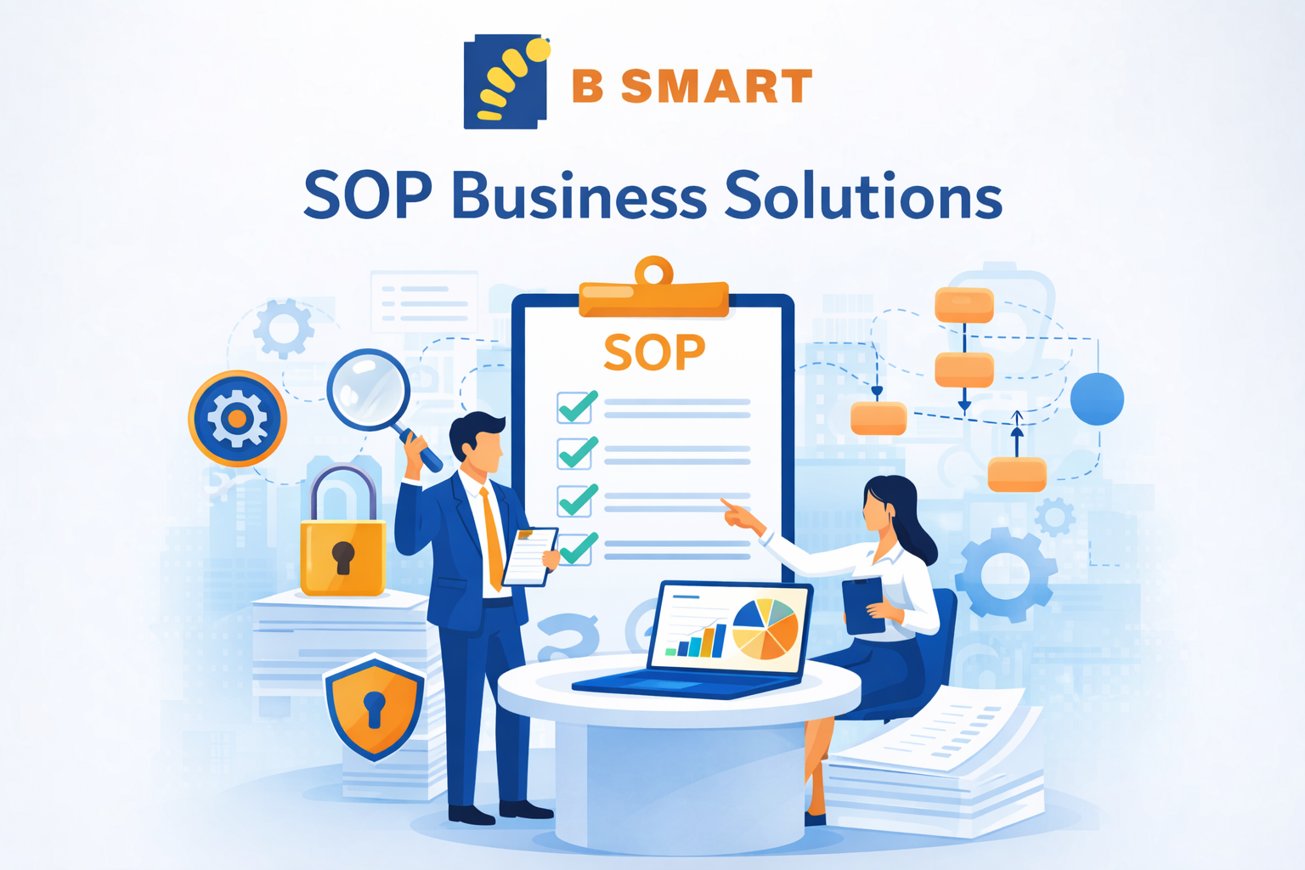
Every growing company reaches a point where things start slipping—not because people aren’t capable, but because processes live inside people’s heads. Tasks are done differently by different team members, quality becomes inconsistent, and founders are pulled into daily firefighting. This is exactly where a strong sop business framework becomes essential. SOPs (Standard Operating Procedures) transform scattered actions into structured systems, allowing businesses to scale smoothly without losing control.
This article explains what SOPs really mean for a business, why they matter beyond documentation, and how they solve real operational challenges.
What Is an SOP Business Model?
An SOP-driven business is one that runs on systems instead of dependency on individuals. SOPs document how tasks should be performed—step by step—so outcomes remain consistent regardless of who executes them.
But SOPs are not boring manuals that sit unused in folders. When implemented correctly, they become living tools that:
- Reduce errors and rework
- Improve accountability
- Speed up onboarding
- Free up leadership bandwidth
In short, SOPs make businesses predictable, scalable, and resilient.
Why Businesses Struggle Without SOPs
Many companies delay SOP creation because things “seem to be working.” But as teams grow, cracks start to show.
Common issues include:
- Repeated mistakes with no clear root cause
- Dependence on a few key employees
- Inconsistent customer experience
- Founder involvement in routine decisions
- Slow onboarding of new hires
Without SOPs, businesses rely on tribal knowledge. When people leave or roles change, that knowledge walks out the door with them.
How SOP Business Systems Solve Real Problems
Problem: Work quality varies from person to person
SOPs standardise how tasks are performed, ensuring consistent output across teams and locations.
Problem: Founders are overloaded with daily operations
With SOPs in place, teams know what to do, how to do it, and when to escalate—reducing dependency on leadership.
Problem: Training new hires takes too long
SOPs act as ready-made training tools, helping new employees become productive faster.
Problem: Accountability is unclear
Well-defined SOPs assign responsibility, timelines, and checkpoints—making performance measurable.
SOPs Are Not Just for Large Enterprises
A common myth is that SOPs are only for large organisations. In reality, small and mid-sized businesses benefit the most.
For growing companies, SOPs:
- Create discipline early
- Prevent chaos during expansion
- Enable delegation without loss of control
- Prepare the business for investors or audits
An SOP-driven business is seen as more professional, reliable, and scalable—especially by investors and strategic partners.
What Makes a Good SOP?
Not all SOPs work. Overly complex or theoretical documents often get ignored.
Effective SOPs are:
- Simple and action-oriented
- Written in clear, non-technical language
- Structured step by step
- Easy to update as processes evolve
The goal is usability, not perfection. SOPs should help teams work better, not slow them down.
SOP Business Solutions: Beyond Documentation
Professional SOP solutions go beyond writing processes on paper. They focus on understanding how your business actually operates.
A structured SOP approach usually includes:
- Process mapping and gap analysis
- Identifying inefficiencies and dependencies
- Standardising best practices
- Aligning SOPs with business goals
- Training teams to adopt SOPs
This ensures SOPs are embedded into daily operations—not treated as compliance paperwork.
SOPs and Business Continuity
One of the most underrated benefits of SOPs is business continuity. Whether it’s leadership absence, employee attrition, or sudden growth, SOPs ensure the business keeps running smoothly.
With SOPs:
- Roles are clearly defined
- Knowledge is documented
- Transitions are smoother
- Risks are reduced
This is especially valuable for founders who want the freedom to step back without worrying about operational breakdowns.
Preparing Your Business for Scale and Growth
If your goal is to scale—whether through expansion, funding, or partnerships—SOPs are non-negotiable. Investors and stakeholders look for businesses that are system-driven, not personality-driven.
An SOP business model signals:
- Operational maturity
- Strong governance
- Lower execution risk
- Long-term sustainability
It shows that the company can grow beyond its current leadership and team structure.
Final Thoughts
SOPs are not about control—they are about clarity. They give teams confidence, leaders freedom, and business stability. An SOP-driven business doesn’t just survive growth—it thrives through it.
If your organisation is facing inefficiencies, burnout, or scaling challenges, investing in structured SOP business solutions could be the turning point that transforms how your company operates—today and in the long run.