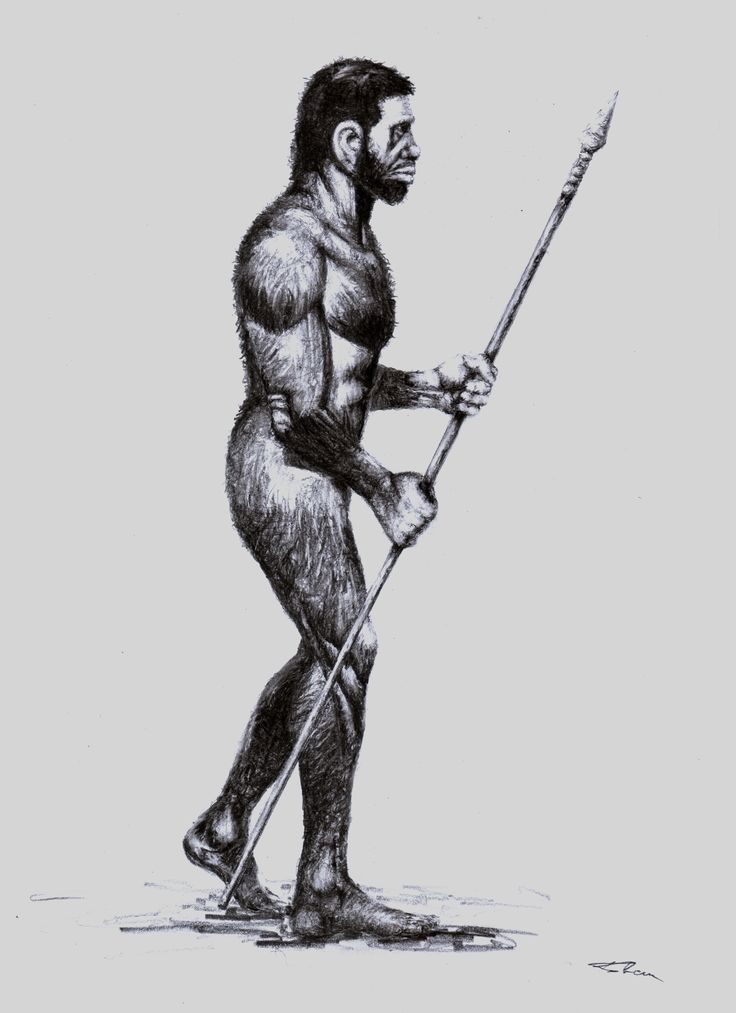
The Mystery of Meganthropus
1. Introduction
Until now, we use a normal classification. Meganthropus and Pithecanthropus are two different races, so they can be classified as different types of hominid. However, there are some experts who consider that Meganthropus is an old form of Pithecanthropus. They tried to reconstruct Meganthropus’ jaw in a form which is simpler than the real condition. Based on this observation, it can be suggested that Meganthropus is an old form of Pithecanthropus. But this is still a heated debate. Let’s look in detail and regard this as a separate species from Pithecanthropus.
Meganthropus is one of the members of the hominid family. It is known as a large race, especially when compared to Pithecanthropus. The remains discovered are a part of a jaw and six lower jaws. Meganthropus was discovered for the first time by Von Koenigswald at Sangiran Solo in 1941. This was followed by other discoveries. They were in 1972 in the same location by Sartono and in 1976 at Site II by Sartono and the team. Based on a number of skeletal remains such as a strong rubidus, jaw bone, and thick skull bone, it can be seen that Meganthropus is bigger than Pithecanthropus. Meganthropus also has more advanced skull creases.
2. Fossil Discoveries
Fossil evidence for the theory of human evolution in Asia is still scanty, but discoveries made in Java caves in the 1930s by a Dutch anthropologist, Dr. G. H. R. von Koenigswald, proved to be of absorbing interest. Many teeth of an early form of man, together with bones and artifacts, were found among the skulls and bones of animals which became extinct between 500,000 and 1,000,000 years ago. This discovery was particularly fascinating because it showed that these early humans already knew how to catch and animals for food. This may indicate that they were the cause of the extinction of the animals, a theory which Von Koenigswald is still researching. At the same time, major discoveries were being made in China. Well-preserved teeth of an early form of man have been found to the south of Peking in a limestone cavern. These were of great age and appeared to be intermediate between the Neanderthal and Java types of human. Then, in a prehistoric cave at Choukoutien near Peking, a complete skull of an early human with all its wisdom teeth present was found, and in nearby strata, a shin bone that was evidently part of a leg bone and hip joint of the same form of human as shown by the teeth. These have been classed as a more advanced form of Peking man and appeared to be about 500,000 years old.
3. Characteristics of Meganthropus
The evidence shows that the fossils belong to at least four different individuals. There is slight individual variation, but on the whole, the characters are so much the same that the conclusion is warranted that they pertain to one and the same kind of man. This species is peculiar in having large size because these fossils are larger than those of the giant Solo man. The teeth of Meganthropus are characterized by megadontia. All the molars have an intermediary groove between the two molar cusps, which is possibly the last remnant of the primitive condition when there were more than two molar cusps. The cusps themselves are much flattened, and the enamel is extra thick, forming a heavy duty. Most remarkable of all is the large, flat, rectangular, chinless jaw with no trace of a chin present at the front. Meganthropus is the only known hominine where the chin seems to be completely absent. A chin is generally thought to be a point of insertion for the digastric muscle associated with the mental plate, and its development seems to be associated with a reduced jaw size. Meganthropus, on the other hand, seems to have increased its size of jaw, moving away from a possible gracile condition still manifest in the older Sangiran hominid. The skull appears to be relatively small for the rest of the body. In one individual, the femoral head morphology suggests a complete inversion load of the hip joint, a condition otherwise known only in modern humans. Meganthropus has been suggested to be bipedal but different from human bipedalism. The inverted hip joint is generally associated with creatures which bear much weight in the hip and thigh region, such as in kangaroos or species of the bear kind. This is a remarkable clue to the biology of Meganthropus. I once suggested that because of the large jaw sizes, the enlarged teeth, and the size of the rest of the body, Meganthropus was a kind of hominid analogue to the panda, a creature which bears a large body size with oversized molar teeth. Meganthropus disappeared from the record around 1 mya. This is a very short duration for a hominine genus, and though it has also been found that the revised dates are closer to 700 kya, the duration for the genus is still little. The reason for the relatively quick disappearance from the record is unknown.
4. Controversies and Debates
The dating of the pygmy Stegodon fossils over the last 20 years has now become a major debate on the age of the early human fossils. Initial dating of the Stegodon and Gigantopithecus fossils has given a wide range from 500,000 years ago to over a million, using the scarce fossil evidence of their time frame on when those species lived and died. The late Dr. Ralph von Koenigswald for the National Geographic Society obtaining information on the stone tools has helped to narrow down the range, giving a date as late as 300,000 years ago when the human species were using those tool types. This has led to continuous testing and re-dating of Homo Erectus and now Meganthropus fossils in an attempt to clearly define their era.
Debates have arisen as to between Meganthropus and Homo Erectus, which has been reinforced by the claim that it was the possible ancestor of Aboriginals and Melanesians due to its similarities to the Wajak Man. The fossil findings of Eastern China have implicated the so-called Helen Theresa Movius Line, a dividing line between the two types of tools the early humans used. North of the line, the Homo Erectus was using the Java man type of tools, and south of the line, the early human was using the Wajak man type of tools, similar to the Aboriginals and early humans of Melanesia. This claim has raised debates as to whether the highly enigmatic Meganthropus was indeed an early human of the south of the line using a different type of tool.
The discoveries of an early human species on Java (Pithecanthropus) as well as in Eastern China at Trinil, Mojokerto, and Sangiran have raised numerous debates and controversies since those years. These fossil findings consist of the skull cap of the Meganthropus (1470), skulls and other bones of the Pithecanthropus, and the skull of the Wajak Man. How those fossils were found and formed, as told by further markings on the skull cap of the Meganthropus, has caused debates on its authenticity. At the time of the first finding of the Meganthropus in the 1940s, it was suggested that it was a large version of Pithecanthropus or an ancestor of the species from a higher era. Opinions have varied, and some researchers today consider the fossils as those of a Homo Erectus.
5. Conclusion
This concluded history of human evolution begins with a migration or dispersal of the more advanced Acheulian culture from East Africa or the Middle East into Java, marking the arrival of Homo erectus. This event may have suppressed and exterminated the Meganthropus culture.
The discovery at Sambungmacan has opened new windows of understanding on human evolution in the Sangiran area. The Sambungmacan locality has shown that the Sangiran area did not only witness the evolution of Meganthropus but also the evolution of Homo erectus. The stratigraphic position of the two hominid forms is still unclear, but the fact that there was an evolution from Meganthropus to Homo erectus is supported by the tools found at the site.
Conclusive evidence of Meganthropus is as difficult to find as the elusive missing link. This is largely due to the paucity of the available materials and the confusion and lack of consensus in the construction of its history. Nevertheless, its position as the most primitive form of known hominid in the Sangiran area and its unique morphological features suggest that it was possibly the direct descendant of the Sangiran hominids, which came to an end around the Middle Pleistocene and the beginning of the Late Pleistocene. A dental report of an orangutan fossil found in Trinil suggests that it may also be possible that Meganthropus was still surviving at the same time as the earliest form of Homo erectus. Meganthropus survived and lived in the Indonesian archipelago for a considerably long time.