In today’s interconnected world, the need for efficient and scalable networking solutions is more crucial than ever. Businesses, institutions, and governments require networks of multiple locations across a city or metropolitan region. This is where Metropolitan Area Networks (MANs) come into play. A MAN is a network that spans a city or large urban area, providing a critical bridge between local area networks (LANs) and wide area networks (WANs). In this article, we’ll explore the concept of a MAN, its key features, how it works, and its applications in various sectors.

What is a Metropolitan Area Network (MAN)?
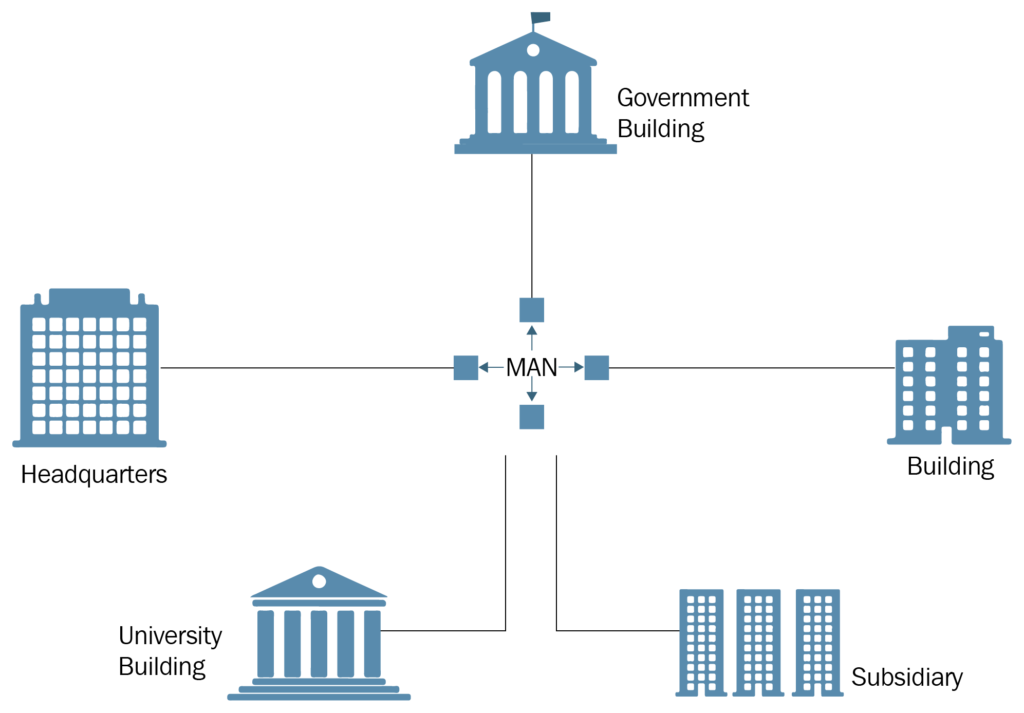
A Metropolitan Area Network (MAN) is a network that connects multiple LANs within a specific geographic region, typically a city or a large metropolitan area. Unlike a LAN, restricted to a small area such as a building or campus, a MAN covers a much broader area. It’s larger than a LAN but smaller than a WAN, which can connect networks across cities or countries.
Businesses, government offices, and institutions often use Metropolitan Area Network to link data and resources across different locations within a metropolitan area. They are in densely populated urban environments, where numerous organizations require fast and reliable communication over relatively long distances.
A Metropolitan Area Network’s Key Features
Several features distinguish a MAN from other types of networks:
- Geographic Range: A MAN typically covers an area of around 5 to 50 kilometers, connecting multiple buildings or campuses within a city. The design of a MAN extends its connectivity beyond a single metropolitan region, surpassing that of a LAN.
- High-Speed Connectivity: MANs frequently use high-speed technologies, such as fiber optic cables, to ensure fast data transfer between locations. Speeds can range from 10 Mbps to 10 Gbps or more, depending on the infrastructure.
- Cost Efficiency: MANs are cost-effective for connecting multiple sites in a metropolitan area. Instead of using separate WAN links for each location, organizations can use a MAN to connect their local networks more efficiently.
- Intermediary Between LAN and WAN: A MAN serves as a bridge between a LAN and a WAN, offering greater geographic coverage than a LAN while providing higher speeds and lower latency than a WAN.
How Does a Metropolitan Area Network Work?
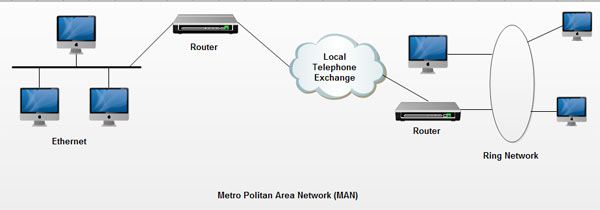
A MAN typically relies on fiber optic cables or other high-speed transmission media to link different LANs across a city or metropolitan area. The network often operates at Layer 2 or 3 of the OSI model, meaning it can function as a data link or network layer system.
Here’s how it works in simple steps:
- The MAN infrastructure connects multiple LANs, typically through routers or switches.
- The MAN uses fiber optic cables or microwave links to transmit data between the connected LANs.
- Data is transmitted at high speeds with minimal latency, ensuring smooth communication between locations.
- You can connect the MAN to the internet or a WAN for broader connectivity beyond the metropolitan area.
Types of Metropolitan Area Networks
- Fibre Distributed Data Interface (FDDI): FDDI is a standard for data transmission in a MAN that uses fiber optics for high-speed communication. Often, scenarios requiring robust and reliable connections employ it.
- Switched Multimegabit Data Service (SMDS): Telecom providers often use SMDS, a high-performance connectionless service, to connect multiple LANs across a metropolitan area. Telecom providers often use it to offer high-speed data services.
- Ethernet-based MAN: Some MANs are based on Ethernet technology, allowing simple integration with existing LANs. This type is cost-effective and provides reliable connectivity.
Applications of Metropolitan Area Networks
MANs are used in sectors, offering reliable communication across urban areas. Some key applications include:
- Business Connectivity: Large businesses with multiple branches or offices in different parts of a city use MANs to ensure seamless data sharing and communication between locations. For example, a company with offices in different districts can use a MAN to connect their networks, enabling fast file sharing, video conferencing, and resource management.
- Government and Public Services: Government agencies often require reliable communication between different offices, such as city halls, police departments, and hospitals. A MAN ensures that critical data can be shared quickly and securely across various government departments, enhancing collaboration and efficiency.
- Educational Institutions: Universities and colleges with campuses spread across a city use MANs to connect their LANs, enabling students and faculty to access resources and share data between buildings or campuses. This makes research collaboration, online learning, and administrative tasks much easier.
- Healthcare Networks: In the healthcare sector, hospitals and clinics use MANs to share medical records, imaging data, and patient information between different locations. This ensures that doctors and healthcare providers have the data they need, regardless of which facility the patient visits.
- Telecommunications: Telecom companies use MANs to offer high-speed Internet, television, and telephone services to businesses and residential customers in urban areas. The network provides the infrastructure necessary to deliver these services efficiently.
Advantages of Metropolitan Area Networks
- High-Speed Connectivity: One of the main benefits of a MAN is its ability to provide high-speed data transfer between different locations. With speeds ranging from 10 Mbps to 10 Gbps, businesses and institutions can rely on fast, seamless communication.
- Cost-Effective: By connecting multiple LANs within a city, MANs help reduce the cost of building separate WAN links. This is especially beneficial for large organizations that need to connect multiple sites in a metropolitan area.
- Scalability: A MAN can expand to accommodate additional locations or increase data traffic. Grows, new LANs can be added to the MAN infrastructure without significant investment.
- Reliable Data Transfer: MANs offer high reliability and low latency, ensuring quickly and without interruptions. This is crucial for industries that require real-time data processing, such as healthcare and finance.
- Enhanced Security: Since a MAN is a private network, it offers better security than public networks like the Internet. Organizations can implement their security protocols to protect sensitive data.
Challenges of Metropolitan Area Networks
- Installation Costs: Although MANs are cost-effective in the long run, the initial setup can be expensive. Installing fiber optic cables and other infrastructure across a city requires significant investment.
- Maintenance: Regular maintenance is to keep the network functioning smoothly. Include upgrading hardware, managing traffic loads, and ensuring the network stays secure.
- Distance Limitations: While a MAN covers a larger area than a LAN, it still has geographic limitations. For longer distances, a WAN may be required.
Conclusion
A Metropolitan Area Network (MAN) is a vital bridge between local and wide-area networks, providing high-speed, reliable connectivity across urban areas. With applications in business, government, education, and healthcare, MANs play a critical role in enabling efficient communication in today’s fast-paced world. Though they come with some installation and maintenance challenges, the benefits of MANs, including cost-efficiency, scalability, and security, make them an essential part of modern networking infrastructure.