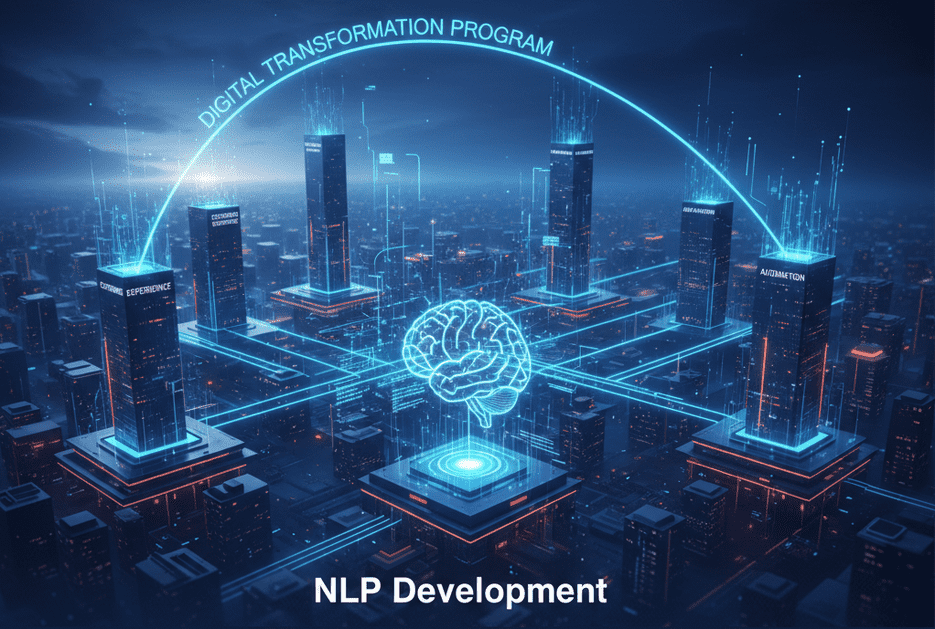
Large-scale digital transformation programs are no longer limited to system upgrades or cloud migrations. For global enterprises and strong startups, transformation now means rethinking how information moves, how decisions are made, and how customers and employees interact with technology. This is where Natural Language Processing Services play a practical and measurable role.
Enterprises generate massive volumes of unstructured data every day. Emails, chat transcripts, documents, contracts, tickets, voice transcripts, and internal knowledge bases often contain more operational insight than structured databases. Yet this data remains underused in many transformation initiatives. NLP changes that equation by allowing systems to read, classify, summarize, and act on language at scale.
This article explains how NLP Development Services align with enterprise digital transformation goals, where they create tangible ROI, and how organizations integrate them responsibly into long-term programs.
Digital transformation demands intelligence beyond dashboards
Most digital transformation programs focus on visibility and automation. Dashboards, analytics platforms, and process automation tools help leaders see what is happening. They do not always explain why it is happening.
Language-based data fills this gap. Customer complaints, support conversations, internal feedback, regulatory documents, and research reports provide context that traditional BI tools cannot interpret on their own. NLP solutions convert this language into structured signals that decision-makers can trust.
In large organizations, this capability supports transformation goals such as:
- Improving customer experience without increasing support headcount
- Reducing operational risk and compliance exposure
- Accelerating decision-making across distributed teams
- Making legacy data usable without full system replacement
This is why NLP is increasingly treated as a core capability rather than an experimental add-on.
Where NLP Development Services create value inside enterprise programs
NLP does not replace existing transformation pillars such as cloud, data platforms, or automation. It strengthens them by adding interpretation and context.
Customer experience modernization
Customer experience initiatives often struggle with fragmented feedback across channels. NLP software development enables enterprises to analyze support tickets, chat logs, surveys, and reviews in one unified layer.
Sentiment analysis, intent classification, and topic clustering help teams identify recurring issues faster than manual review. This reduces response times, improves escalation logic, and supports proactive service design.
For enterprises operating across regions and languages, NLP also enables multilingual analysis without duplicating processes.
Operational efficiency and internal automation
Many digital transformation programs aim to reduce manual effort in operations. Language-heavy processes are often overlooked because they are difficult to automate with rules alone.
Natural Language Processing development services support:
- Automated document classification and routing
- Extraction of key fields from contracts and invoices
- Knowledge base search for internal teams
- Intelligent assistants for IT, HR, and procurement
These capabilities reduce dependency on human review while improving consistency and auditability.
Risk management and compliance support
Enterprises in regulated industries face constant pressure to monitor communications, documentation, and reporting. NLP enables continuous analysis of large text volumes to identify policy violations, sensitive language, or emerging risks.
Instead of relying on periodic audits, organizations gain near real-time visibility. This aligns with transformation goals focused on resilience and governance rather than speed alone.
How NLP integrates with broader transformation architecture
A common misconception is that NLP rires isolated systems or full platform replacement. In practice, mature NLP Development Services are designed to integrate into existing enterprise ecosystems.
NLP models typically sit alongside data platforms, APIs, and workflow engines. They consume text from multiple sources and return structured outputs such as tags, scores, summaries, or alerts. These outputs feed into CRM systems, ERP workflows, analytics dashboards, or automation tools.
This architecture-first approach allows transformation leaders to:
- Pilot NLP use cases without disrupting core systems
- Scale successful models across departments
- Maintain security and data governance standards
An experienced NLP development company understands how to design these integrations to match enterprise constraints, not just technical ambition.
Governance, scale, and trust in NLP deployments
Digital transformation programs live or die by governance. NLP is no exception. As language models influence decisions, enterprises must ensure transparency, security, and accountability.
Key considerations include:
- Data privacy and access controls for sensitive text
- Model explainability for regulated decisions
- Bias monitoring across regions and demographics
- Clear ownership between IT, data, and business teams
A Natural Language Processing Company with enterprise experience will address these concerns from the design stage rather than as an afterthought. This reduces friction during audits and builds confidence among stakeholders.
Industry research consistently shows that governance-ready AI initiatives scale faster and face fewer operational setbacks.
Measuring ROI from NLP within transformation programs
Decision-makers rightly ask how NLP contributes measurable value. ROI typically appears in three areas.
First, cost reduction through automation of manual review and classification tasks. Second, revenue protection and growth through improved customer experience and faster issue resolution. Third, risk reduction through earlier detection of compliance or operational issues.
Unlike isolated pilots, NLP delivers sustained returns when embedded into core workflows. Transformation programs that treat NLP as infrastructure rather than experimentation see higher long-term impact.
Choosing the right approach to NLP development
Not all NLP initiatives require the same level of customization. Some use cases can rely on pre-trained models, while others require domain-specific training and integration.
A capable NLP development company helps enterprises decide:
- Where custom models are necessary
- How to reuse components across departments
- When to prioritize accuracy over speed
- How to plan for ongoing model improvement
This strategic guidance is often more valuable than model accuracy alone. It ensures that NLP Development Services support transformation goals over multiple years, not just initial deployment.
NLP as a long-term transformation enabler
Large-scale digital transformation is not a one-time initiative. It is an ongoing process of learning, adaptation, and optimization. NLP fits naturally into this model because language remains central to how organizations operate.
By converting text into insight, NLP bridges the gap between systems and people. It allows enterprises to scale understanding, not just automation. For global organizations managing complexity across markets, this capability becomes a competitive necessity.
As transformation programs mature, Natural Language Processing development services increasingly move from experimental pilots to foundational platforms. Enterprises that invest early and govern wisely position themselves to extract sustained value from their data and decisions.
For leaders evaluating the next phase of their transformation roadmap, NLP is no longer a future consideration. It is part of the present architecture.