|
Can AI Models Forget What They Learned? |
|
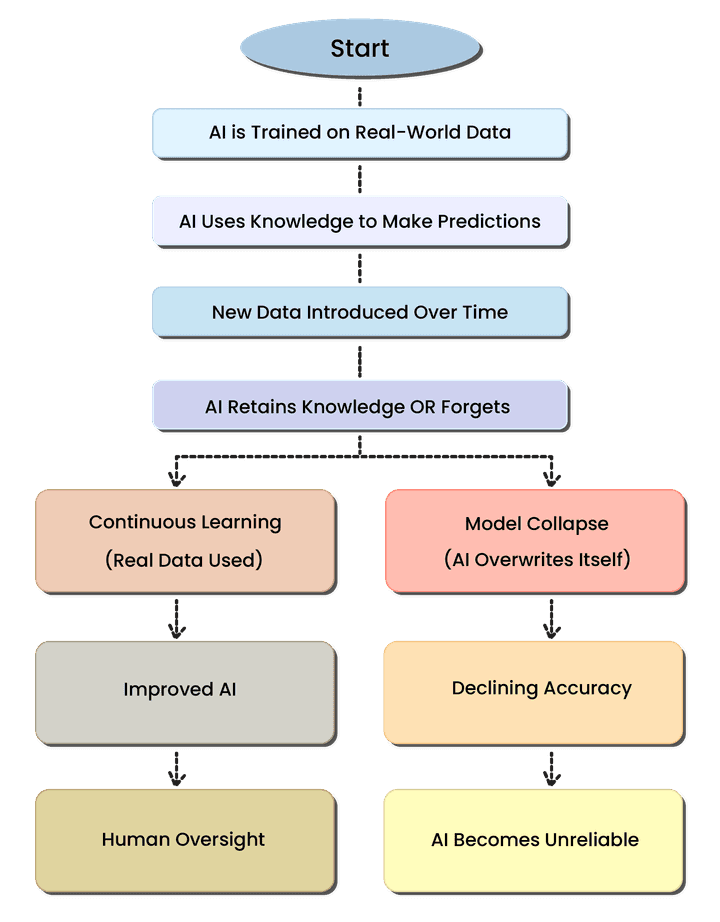
While artificial intelligence is designed to retain and apply learned knowledge, it can also lose or degrade information over time, a phenomenon known as “Model collapse.” This occurs when AI repeatedly trains on its own generated data instead of fresh, real-world information, leading to a loss of accuracy, relevance, and even logical consistency. |
|
Let’s dive deeper into why AI forgets and how we can prevent it. |
Why Do AI Models Forget? |
The Nature of AI Memory |
|
1. Data Overwriting
|
|
2. Unlearning Techniques
|
|
3. Limited Memory & Storage
|
|
4. Data Distribution Shifts
|
Types of AI Forgetting & Their Impact |
|
Type of Forgetting |
|
Description |
|
Impact |
|
Catastrophic Forgetting |
|
AI loses past knowledge when trained on new data |
|
Declining accuracy in long-term predictions |
|
Concept Drift |
|
AI’s understanding shifts due to changing data trends |
|
Poor adaptation to real-world changes |
|
Bias Reinforcement |
|
AI forgets diverse perspectives due to repetitive training on AI-generated data |
|
Increased biases in decision-making |
|
Security-Driven Forgetting |
|
Intentional removal of sensitive data |
|
Helps with compliance but may create knowledge gaps |
Flowchart: How AI Learns, Forgets, and Recovers |
|
How AI Can Learn from Mistakes |
|
Even though AI can forget, it can also improve through continuous learning techniques: |
1. Error Detection & Feedback Loops |
|
2. Model Updates & Fine-Tuning |
|
3. Reinforcement Learning |
|
How to Prevent AI from Forgetting |
1. Use Diverse, Real-World Data |
|
2. Implement Hybrid Learning Approaches |
|
3. Regular Model Audits |
|
4. Allow User Feedback for Corrections |
|
The Future of AI Learning & Unlearning |
|
As AI evolves, the ability to learn and unlearn efficiently will be critical for: |
|
|
By focusing on balanced learning, AI can retain accuracy, prevent biases, and remain a powerful tool for the future. |
Continuous Learning |
|
AI is not perfect, and like human memory, it can be forgotten if not properly managed. The key to ensuring AI remains accurate and useful lies in continuous learning, human oversight, and high-quality real-world data. |
|
AI is in a constant state of evolution, adapting through structured learning, ethical unlearning, and real-world feedback. By refining data inputs and applying human oversight, we ensure AI remains accurate, fair, and relevant. This continuous improvement process helps AI grow responsibly, avoiding biases while enhancing adaptability. The future of AI depends on its ability to evolve while staying aligned with ethical and societal needs. |