Cell and Tissue Culture Media, Reagents and Buffers: Foundations of Modern Biomedical Research

Introduction
Cell and tissue culture techniques form the cornerstone of modern biomedical research. From drug discovery and cancer biology to regenerative medicine and virology, scientists rely on the controlled environment of cell culture systems to unravel complex biological processes. At the heart of these systems lie culture media, reagents, and buffers – essential components that support cell survival, growth, and experimental reproducibility.
Definition
Cell and Tissue Culture Media Reagents and Buffers are prepared solutions and additives used to support the in vitro growth, maintenance, and experimentation of cells and tissues. They supply essential nutrients, growth factors, salts, and pH-stabilizing components that create controlled physiological conditions, ensuring cell viability, functionality, and reproducibility in research, diagnostic, and biomanufacturing applications.
What Is Cell and Tissue Culture?
Cell and tissue culture refers to the in vitro (outside the organism) growth of cells or tissues under controlled laboratory conditions. Researchers use this method to:
- Model physiological processes
- Test drug efficacy and toxicity
- Study cellular responses to genetic or environmental changes
- Produce biologics like vaccines and therapeutic proteins
Successful culture conditions require an environment that mimics the cell’s natural habitat. Cells need nutrients, energy sources, proper pH, osmotic balance, and essential growth factors. This is where culture media, reagents, and buffers become indispensable.
Culture Media: Nutrient Platforms for Cells
Culture media are complex solutions of nutrients and biologically active components that simulate the extracellular environment. They are the lifeblood of any cell culture experiment.
Basic Components of Culture Media
- Salts and Minerals
Maintain osmotic balance and provide essential ions like sodium, potassium, calcium, and magnesium – critical for cellular functions such as membrane potential and enzyme activity. - Energy Sources
Simple sugars like glucose offer energy for metabolism. - Amino Acids
Building blocks for protein synthesis. - Vitamins and Cofactors
Required for enzyme function and metabolic processes. - Serum or Defined Supplements
Many media include serum (e.g., fetal bovine serum) that supplies hormones, growth factors, and binding proteins. Serum-free defined formulations eliminate variability for more consistent results.
Types of Culture Media
Culture media vary based on cell type, species origin, and experimental goals. Some common types include:
1. Basic Media
Buffered solutions with salts, sugars, and amino acids. Examples include:
- Eagle’s Minimum Essential Medium (MEM)
- Dulbecco’s Modified Eagle’s Medium (DMEM)
- RPMI 1640
These formulations are suited for general cell growth but may require supplements like serum for optimal performance.
2. Specialized Media
Engineered for specific cells like stem cells, primary cells, or hybridomas. These media often contain growth factors and cytokines to maintain unique cell states.
3. Serum-Free and Chemically Defined Media
To reduce variability, researchers use media with precise molecular compositions. This enhances reproducibility, especially in biopharmaceutical production.
Reagents: Tools for Manipulating Cellular Processes
Reagents in cell culture are bioactive substances used during experiments to analyze, preserve, or alter cellular conditions.
Types of Reagents
- Antibiotics and Antimycotics
Prevent bacterial and fungal contamination but must be used judiciously to avoid masking underlying issues. - Trypsin and Cell Detachment Solutions
Enzymatic reagents that detach adherent cells from culture surfaces for passaging or analysis. - Transfection Reagents
Facilitate the introduction of DNA, RNA, or proteins into cells for genetic manipulation. - Fluorescent Dyes and Stains
Used to visualize cellular components, track cell health, or quantify molecules in assays. - Protease and Phosphatase Inhibitors
Preserve protein states during extraction and analysis.
Each reagent must be carefully validated for its specific cell type and application to maintain data integrity.
Buffers: Guardians of Cellular Stability
Buffers are solutions that maintain stable pH levels during culture and experimental procedures. Cells are highly sensitive to pH changes; even small fluctuations can alter metabolism, gene expression, and viability.
Common Buffers in Cell Culture
- Phosphate-Buffered Saline (PBS)
Maintains isotonic conditions and pH during washing steps. - HEPES Buffer:
Provides stable pH in ambient CO₂ conditions, especially useful during imaging. - Tris and MOPS Buffers:
Used in protein analysis and molecular biology protocols.
Buffers are critical in maintaining a constant environment, particularly during manipulations outside of the CO₂-controlled incubator.
Quality Matters: Why Media, Reagents and Buffers Must Be Optimized
High-quality media, reagents, and buffers aren’t luxuries – they are necessities for reliable, reproducible science. Poor quality or contaminated solutions can cause:
- Reduced cell viability
- Altered cellular behavior
- Experimental variability
- Data that cannot be replicated
As science moves toward open and reproducible research standards, optimizing these components is key to generating meaningful results that withstand peer scrutiny.
Applications Fueled by Culture Systems
Cell and tissue culture media, reagents, and buffers underpin discoveries across a spectrum of disciplines.
1. Drug Discovery and Toxicology
Pharmaceutical companies use cultured cells to screen thousands of compounds for efficacy and toxicity before moving to animal models or clinical trials. Media formulations must support relevant cell phenotypes for predictive outcomes.
2. Cancer Research
Cancer cells grown in vitro reveal insights into tumor behavior, metastasis, and resistance mechanisms. Tailored media can sustain difficult-to-culture tumor cells to enable meaningful studies.
3. Stem Cell and Regenerative Medicine
Stem cells require specialized media rich in growth factors to propagate without differentiation (for pluripotent states) or to guide differentiation into specific tissue types for therapeutic applications.
4. Vaccine and Biologics Production
Cells are used to produce proteins like antibodies, vaccines, and enzymes. Consistent culture conditions are critical for high-yield and safe products.
Emerging Trends in Media and Reagents
The field continues to evolve with innovations that push boundaries of what’s possible in culture systems.
1. Serum-Free and Xeno-Free Media
Efforts to eliminate animal-derived components reduce ethical concerns and variability, particularly important for clinical applications.
2. 3D Culture and Organoids
Moving beyond flat petri dishes, 3D cultures better mimic tissue architecture. Media and reagents are being redesigned to support complex multicellular structures.
3. Automated and High-Throughput Systems
Automation enables researchers to test multiple conditions simultaneously—critical for systems biology and precision medicine.
4. Synthetic Biology and Custom Media
Custom media tailored to engineered cells allow for precise control of metabolic pathways and production systems.
Growth Rate of Cell and Tissue Culture Media Reagents and Buffers Market
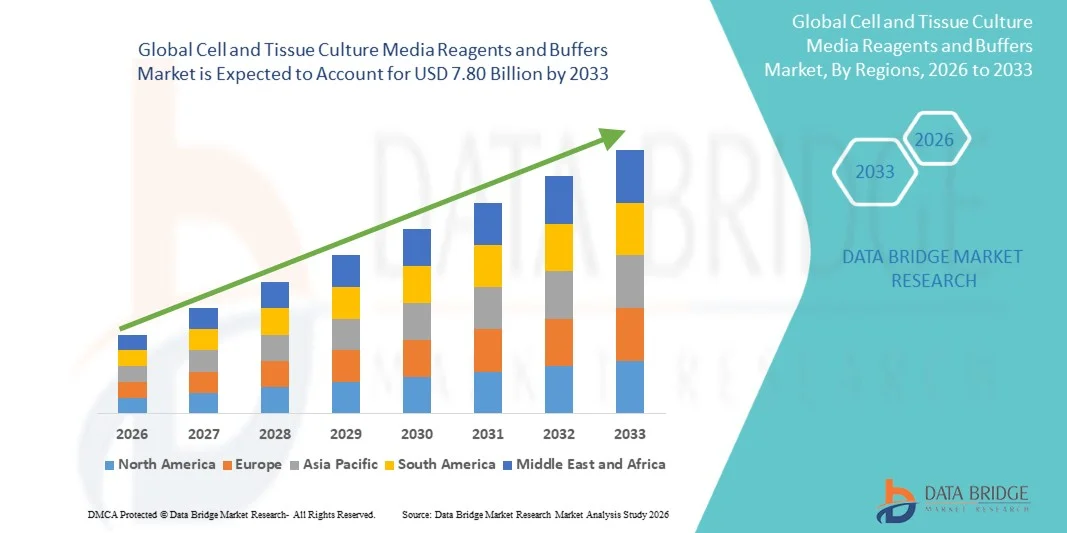
According to Data Bridge Market Research, the Cell and Tissue Culture Media Reagents and Buffers Market was estimated to be worth USD 3.72 billion in 2025 and is projected to grow at a compound annual growth rate (CAGR) of 9.70% to reach USD 7.80 billion by 2033.
Conclusion
Culture media, reagents, and buffers are far more than laboratory solutions – they are the foundation stones of modern biomedical research. By providing controlled environments, these components make it possible to grow, manipulate, and study cells in ways that transform our understanding of biology and disease.