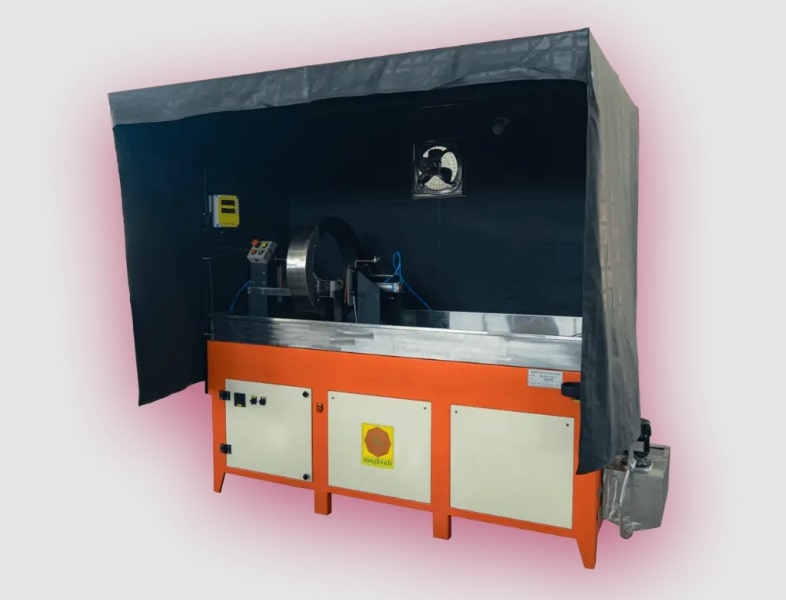
In today’s competitive industrial landscape, ensuring the quality and integrity of components is vital, regardless of business size. Magnetic Particle Testing (MPT) stands out as a trusted non-destructive testing (NDT) method that helps detect surface and near-surface flaws in ferromagnetic materials. Magnetic particle testing equipment is an essential investment for both small and large industries, ensuring components are free from defects that could compromise safety and functionality.
This guide offers insight into magnetic particle testing machines and the types of equipment suitable for various industry needs.
Understanding Magnetic Particle Testing (MPT)
Magnetic Particle Testing (MPT) is a non-destructive testing method used to identify cracks and flaws on or near the surface of ferromagnetic materials, such as iron, steel, and other alloys. This process involves:
- Magnetizing the Component: The component is magnetized, creating a magnetic field within the material.
- Applying Magnetic Particles: Fine magnetic particles are applied to the surface, either as a dry powder or suspended in liquid.
- Detecting Defects: If there is a flaw, it interrupts the magnetic field, causing the particles to gather at the site of the defect, making it visible to inspectors.
The simplicity and reliability of this method make magnetic particle testing equipment ideal for industries requiring rigorous quality control, including aerospace, automotive, oil and gas, and heavy manufacturing.
Types of Magnetic Particle Testing Equipment
When choosing magnetic particle testing equipment, it’s essential to consider the specific needs of your industry, the component sizes, and the inspection environment. Here are the main types of equipment suitable for different setups:
1. Portable Magnetic Yokes
Portable magnetic yokes are compact and versatile devices commonly used for field inspections. They are suitable for inspecting large, irregularly shaped components on-site, making them ideal for industries where parts cannot be transported to a testing facility.
- Best for: Small businesses, on-site inspections, and industries where components are inspected in the field, such as oil and gas pipelines.
- Advantages: Easy to carry, simple to operate, and suitable for inspecting larger components.
- Limitations: Portable yokes are less precise than benchtop or automated systems and may require more manual effort for consistent results.
2. Benchtop Units
Benchtop units provide a stable, controlled environment for inspecting smaller or medium-sized parts with precision. These units are typically found in manufacturing facilities and labs where consistency and accuracy are priorities. They come with features like adjustable magnetization levels and built-in lighting for enhanced visibility.
- Best for: Small and medium-sized businesses with in-house testing facilities, including automotive and manufacturing sectors.
- Advantages: Precise, stable setup, ideal for repeat testing of similarly sized components.
- Limitations: Less suitable for large or irregularly shaped parts that are challenging to handle on a benchtop.
3. Automated Magnetic Particle Testing Systems
For large-scale industries with high inspection volumes, automated systems offer the fastest, most consistent results. These machines are designed to be part of production lines, allowing for rapid inspection without compromising quality. Automated systems are highly efficient for industries that prioritize both speed and accuracy, such as aerospace and heavy manufacturing.
- Best for: Large industries with high-volume production and stringent quality requirements, such as aerospace and automotive.
- Advantages: High throughput, consistent results, minimal manual intervention, and integration into production lines.
- Limitations: More expensive than other types of MPT equipment, requiring significant initial investment and maintenance.
4. Coils and Headstock/Tailstock Systems
For cylindrical parts such as pipes and rods, coils and headstock/tailstock systems are highly effective. They create a magnetic field around the entire component, making them ideal for cylindrical or symmetric parts where uniform magnetization is needed.
- Best for: Industries that work with long, cylindrical parts, like pipeline manufacturing and mechanical engineering.
- Advantages: Effective for detecting flaws in cylindrical parts, quick inspection, and efficient magnetization.
- Limitations: Limited to specific shapes and sizes, making them unsuitable for a variety of parts.
Key Factors to Consider When Selecting Magnetic Particle Testing Equipment
Choosing the right magnetic particle testing machine depends on several factors. Here’s what to keep in mind to ensure your selection matches your business requirements:
1. Component Size and Shape
Different magnetic particle testing equipment is suited to specific component shapes and sizes. For example:
- Portable yokes work well for large, irregular components.
- Benchtop units are ideal for smaller, standardized parts.
- Coil systems are effective for cylindrical components.
2. Inspection Environment
If you perform inspections on-site, portable equipment will be essential. However, if you have a dedicated testing facility or lab, a benchtop unit or automated system may offer the stability and precision needed for consistent results.
3. Industry-Specific Requirements
Industries like aerospace and oil & gas often require highly accurate testing due to safety-critical applications. Automated or high-sensitivity magnetic particle testing machines are ideal in such cases. For industries like automotive or general manufacturing, benchtop units may be sufficient for in-house quality control.
4. Budget and Return on Investment (ROI)
The cost of MPT equipment varies widely based on features, automation level, and brand. While larger, automated systems are more expensive, they can offer higher ROI by streamlining the inspection process in high-volume industries. Smaller businesses may benefit from more affordable benchtop units or portable yokes, which still offer reliable results at a lower cost.
Advantages of Magnetic Particle Testing for Small and Large Industries
MPT equipment is valued across industries for its versatility and efficiency. Here’s why it’s a great fit for both small and large businesses:
For Small Industries
- Cost-Effective: MPT machines, especially portable yokes or benchtop units, are affordable and accessible for small businesses.
- Ease of Use: Simple to operate, with minimal training required, making it practical for companies with smaller testing teams.
- Adaptable: Portable options allow for flexibility in inspection locations, accommodating various testing needs.
For Large Industries
- High-Volume Efficiency: Automated MPT systems handle large volumes with consistency, essential for industries with extensive production lines.
- Reliable Defect Detection: Ensures safety and quality in high-stakes environments like aerospace and oil & gas.
- Scalability: Large industries benefit from investing in sophisticated MPT systems that can integrate into production lines, saving time and resources.
How to Get Started with Magnetic Particle Testing Equipment
To implement magnetic particle testing machines effectively, consider the following steps:
- Assess Your Needs: Identify your industry’s specific safety and quality standards. Determine the component types and inspection environments.
- Evaluate Equipment Options: Choose between portable, benchtop, or automated systems based on your inspection volume, budget, and facility requirements.
- Train Operators: Ensure operators understand the equipment’s functionality, safety protocols, and defect interpretation to maximize inspection accuracy.
- Regular Maintenance: Routine maintenance is key for keeping MPT equipment in optimal condition, ensuring consistent performance over time.
Conclusion
Whether you’re a small business or a large industrial operation, choosing the right magnetic particle testing equipment is essential for maintaining quality control and safety standards. With various options available—from portable yokes to fully automated systems—there’s a suitable solution for every industry’s needs.
By investing in the right Magkraft’s magnetic particle testing machine, you can ensure that your products meet the highest standards of reliability and integrity, helping you protect your business, customers, and reputation.