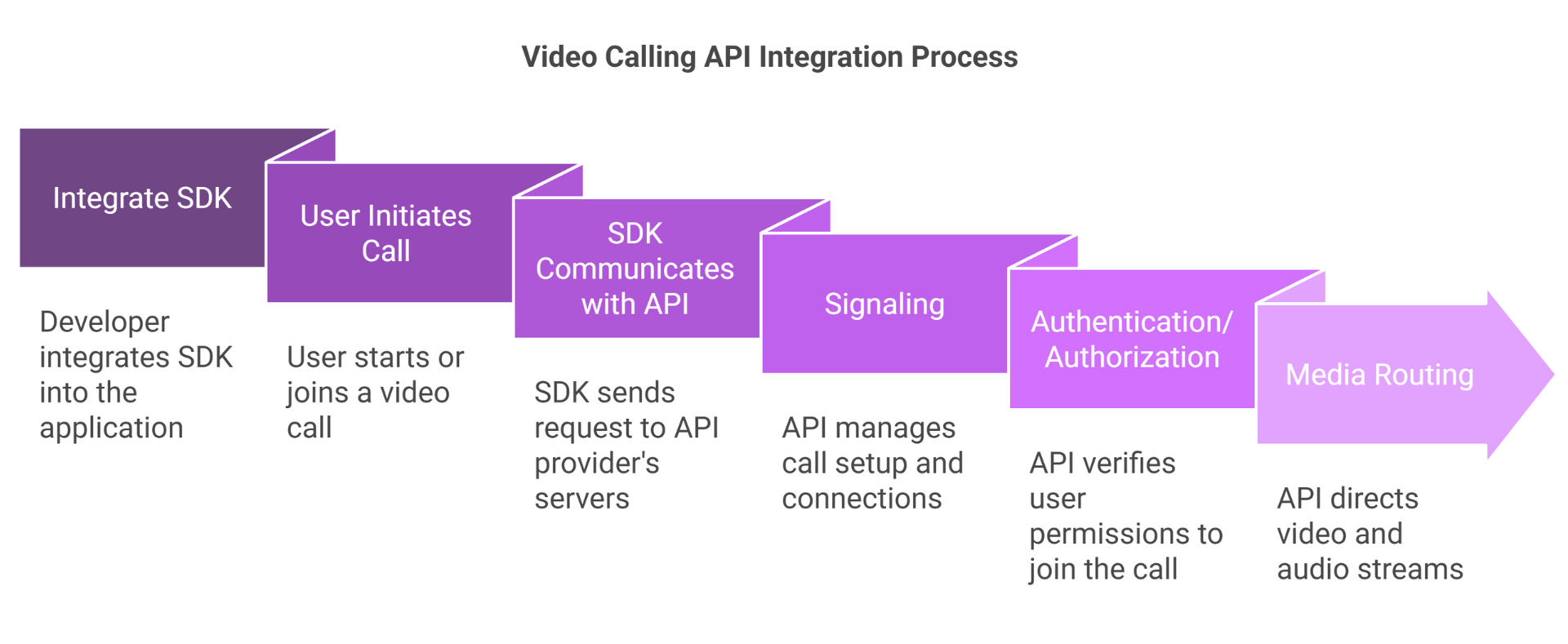
What it is: A Video Calling API (Application Programming Interface) is a set of pre-built code, protocols, and tools provided by a service provider. It allows developers to easily integrate real-time video (and audio) communication features directly into their own applications (web, mobile, desktop) without having to build the complex underlying infrastructure from scratch.
How it works: Typically, developers integrate the provider’s SDK (Software Development Kit) into their application. When a user initiates or joins a call, the SDK communicates with the API provider’s backend servers. These servers handle tasks like:
Signaling: Managing connections, call setup, and teardown (who is in the call, their status).
Authentication/Authorization: Ensuring only authorized users can join specific calls, often using tokens generated by your backend.
Media Routing: Directing the video and audio streams between participants. This might be Peer-to-Peer (P2P) for 1-on-1 calls or use media servers (like SFUs or MCUs) for group calls or complex scenarios.
NAT Traversal: Helping devices connect even if they are behind firewalls or NATs (using STUN/TURN servers).
What are the key features of a Video Calling API?
Real-time video and audio streaming
Group video calling (multi-party)
Screen sharing capabilities
Text chat/messaging within the call
Call recording (cloud or local)
Cross-platform support (Web, iOS, Android, sometimes desktop SDKs)
Adaptive bitrate streaming (adjusting quality based on network)
Presence indication (showing user status)
Mute/unmute audio and enable/disable video controls
Customizable User Interface (UI) options
Security features (encryption, authentication)
Analytics and call quality statistics
How does a Video Calling API ensure secure communication?
Encryption in Transit: Using protocols like TLS (Transport Layer Security) for signaling and DTLS-SRTP (Datagram TLS – Secure Real-time Transport Protocol) to encrypt the actual video/audio media streams between participants and servers.
End-to-End Encryption (E2EE): Some APIs offer optional E2EE where only the participants can decrypt the media, not even the provider’s servers (though this may limit server-side features like recording).
Authentication & Authorization: Using secure tokens (often short-lived JWTs) generated by your server to authenticate users and authorize them to join specific rooms or conversations. API Keys/Secrets are kept server-side.
Secure Infrastructure: Providers manage secure data centers and infrastructure, often adhering to security best practices and certifications (like SOC 2).
Compliance: Adherence to regulations like GDPR and HIPAA (often required for specific industries like healthcare).
What are the best Video Calling APIs available?
“Best” depends on specific needs (features, scale, price, platform). However, some popular and well-regarded providers include: