If you’re an eCommerce seller or managing product listings across platforms like Google Shopping, Amazon, or Shopify, you’ve probably come across the terms GTIN and UPC. You might’ve even wondered—are GTIN and UPC the same? While they are closely related, they’re not identical. Understanding their differences and how they work together can significantly impact your product visibility and compliance.
In this blog, we’ll explain GTIN vs UPC, their use cases, and why getting them right is essential for your eCommerce success.
What is GTIN?
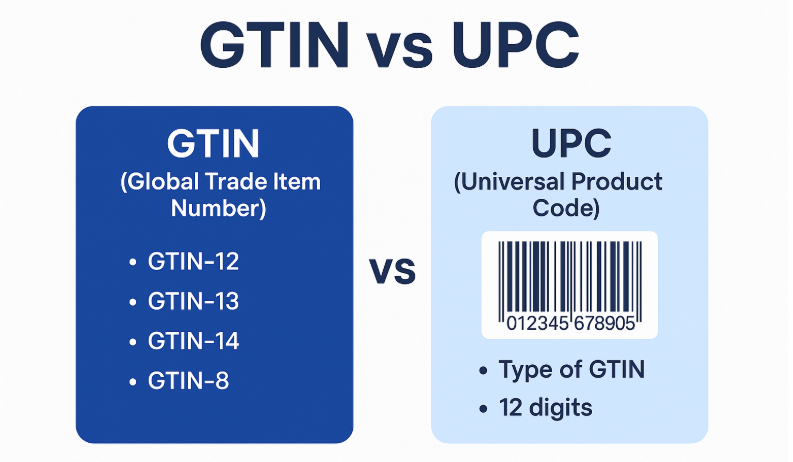
GTIN, or Global Trade Item Number, is a globally recognized identifier for products. It’s used to uniquely identify items across borders and retail systems. GTINs can vary in length depending on the type of product and region:
-
GTIN-12: Commonly used in the U.S. and Canada (also known as UPC)
-
GTIN-13: Common in Europe and other parts of the world (also called EAN)
-
GTIN-14: Used for grouping products in shipments
-
GTIN-8: A shorter version used for smaller products
A GTIN is assigned by GS1, a global organization that ensures consistency in product identification across industries.
What is a UPC?
UPC, or Universal Product Code, is a specific type of GTIN—specifically, a GTIN-12. It’s the 12-digit number you see below the barcode on most products sold in the United States and Canada. UPCs are the most widely recognized barcodes in North America and are used by retailers, warehouses, and marketplaces for scanning and inventory purposes.
GTIN vs UPC: What’s the Real Difference?
At first glance, GTIN and UPC might seem interchangeable, and in many cases, they are used together. But here’s the key difference:
-
GTIN is the broader category—it includes several formats like GTIN-8, GTIN-12 (UPC), GTIN-13 (EAN), and GTIN-14.
-
UPC is a specific type of GTIN, limited to 12 digits, used primarily in North America.
So, in simple terms: All UPCs are GTINs, but not all GTINs are UPCs.
Why Does This Matter for eCommerce?
Many online platforms—including Google Merchant Center, Amazon, and Walmart Marketplace—require product identifiers like GTINs or UPCs to list items. These identifiers help:
-
Verify product authenticity
-
Improve product matching
-
Enhance search visibility
-
Ensure accurate inventory tracking
Google, for example, mandates GTINs for certain categories and provides guidance in its Merchant Center Help documentation. A small mistake—like entering the wrong GTIN or confusing it with another format—can result in listing rejections, poor SEO performance, or incorrect inventory data.
Common Seller Mistake: GTIN vs UPC Confusion
One of the most frequent issues sellers face is uploading product feeds without the correct GTIN or using a self-generated UPC that isn’t GS1-certified. This can lead to disapproved listings or reduced trust from buyers and platforms.
If you’re unsure whether your UPC is valid, you can check it using GS1’s Global Electronic Party Information Registry (GEPIR) or through the platform’s diagnostics tools.
Final Thoughts: GTIN and UPC Work Together
When it comes to GTIN vs UPC, think of it as a hierarchy. GTIN is the global standard, and UPC is a regional format that fits within that standard. For sellers, understanding both terms—and knowing when and where to use them—is crucial for optimizing product listings and staying compliant with platform requirements.
In short: use the right identifiers, and your products will be easier to find, approve, and manage across platforms.