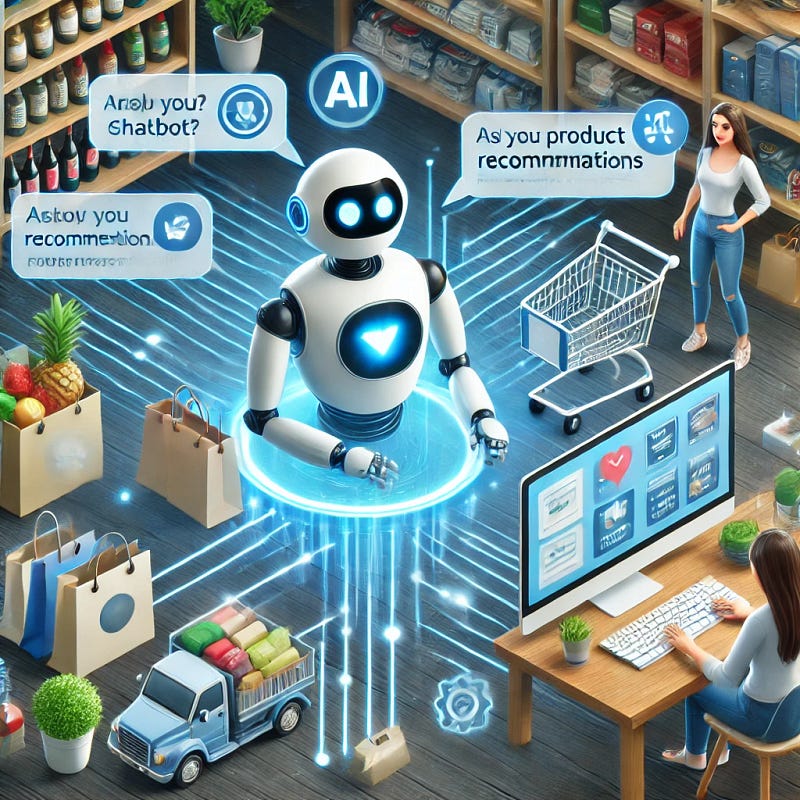
Artificial Intelligence ( a fantasy of the future. Now it’s making a real difference to how organisations work. One of the greatest advantages of AI for business is that it supports decision-making and prediction. AI’s ability to analyse large datasets and give clear and actionable outputs is helping organisations to make better decisions, improve processes and anticipate developments in the future.
Let’s see how exactly AI is changing the way decisions get made in business, by looking at predictive analytics and decision-making based on real-time data analysis. Let’s see some use cases in finance, healthcare, operations and in marketing. Finally, let’s turn our attention to the ethical implications of AI-powered decision-making.
- AI and Predictive Analytics: Transforming Data into Insights
Predictive analytics is one of the most useful tools that AI provides to business today. Machine learning have the ability to analyse past data to identify trends and then make predictions based on them. With the help of AI, the future states of systems and processes can be predicted, and advance action can be taken before problems arise.
1.1 How AI-Driven Predictive Analytics Works
Predictive analytics involves the use of statistical techniques (eg, regression analysis, classification and clustering), machine learning, and data mining to predict future occurrences and trends, and AI further improves the effectiveness by enhancing the predictive accuracy. Machine learning models can be trained on historical data to detect patterns and trends, and this knowledge can be utilised in predicting future occurrences.
For instance, an AI model might analyse historical sales data to forecast how much inventory a retailer will need to buy for the upcoming holiday season. Proper demand forecasting allows businesses to buy enough inventory without overspending, or failing to meet customer demand.
1.2 Case Study: AI in Retail Demand Forecasting
One leading e-commerce site used AI-based predictive analytics to analyse the behaviour of its existing customers and predict what they would purchase in the coming quarters. By being able to process massive sets of data in real-time, the organisation was able to better curate its inventory, optimise stockouts, and suggest personalised recommendations to customers, all of which helped it boost sales by 15 per cent.
- AI in Financial Decision-Making
And it was the financial sector that was among the first to use AI technology, with AI-based predictive analytics increasingly used to develop automated systems that can enhance decision-making in areas such as risk management, investment strategies and real-time trading.
2.1 AI in Real-Time Financial Market Analysis
Financial markets are highly volatile. Prices change constantly in response to a range of factors. AI software can use past market data, news and economic indicators to predict price movements and provide guidelines for trades. Since AI systems can process and interpret market information faster than any human trader, financial institutions have an advantage in making instantaneous decisions.
2.2 AI in Investment Strategies
Elsewhere, AI has a role in investment strategy. Machine learning algorithms can be applied to historical market data and macroeconomic trends, so investment selection can become more predictable. It’s about better forecasting, and improving the portfolio in the process.
For example, hedge funds such as Renaissance Technologies use AI to develop algorithmic trading models that outperform conventional trading strategies by scanning large volumes of data and extracting patterns that human traders would likely miss.
2.3 Risk Management and Fraud Detection
Besides investment strategies, another important application of AI is in risk management: financial institutions use AI to analyse credit risk and detect fraud and other breaches of bank regulations. By producing electronic models of risk, AI can detect anomalous transactions and flag them for review, thereby averting losses due to fraud.
- Improving Operational Efficiency with AI in Decision-Making
Rather than just finance and marketing, AI is integration, automating decision-making across all operations to make faster, smarter, more data-informed decisions about supply chain management, human resources, logistics and more.
3.1 AI-Driven Supply Chain Optimization
In supply chain management, AI can predict where bottlenecks in the process will occur and tweak inventory levels and delivery routes to get products into the hands of customers faster than ever. AI can also anticipate reordering points, reducing costs, optimising supply chain efficiency, and enhancing the customer experience. It can work to identify shortages before they occur and provide business executives with real-time data to react to disruptions before they result in a loss of customers for companies.
Example: the shipping company UPS uses AI to rework its delivery routes to take account of traffic patterns, weather, fuel prices, fuel efficiency and other factors, thus saving time and money.
3.2 AI in Human Resources: Automating Recruitment
Right now, other areas where AI is reinventing business processes include recruitment and talent management. AI-enabled recruitment systems can analyse CVs, conduct interviews and assess candidates, helping companies reduce time and costs related to hiring, and enhance the quality of the hires. AI can also analyse employee performance and provide development plans to help businesses retain their top talent.
Example: An organisation in the tech sector used AI-powered hiring software to automatically screen candidates’ résumés and schedule interviews, reducing time-to-hire by 30 per cent and increasing the quality of new hires.
- AI in Healthcare Decision-Making
the fact is, AI has proven to be an invaluable tool in today’s healthcare systems, helping to make decisions about diagnosing, managing care plans for patients, and ultimately assisting in saving lives AI systems can also analyse medical data and contribute to diagnostics; as well as help to recommend treatments for specific patients based on their health profile.
4.1 AI in Diagnostic Decision Support
Diagnostic tools powered by AI can make sense out of medical images and patient data more quickly and accurately than human doctors. It can detect early signs of disease in, for example, X-ray images that the human eye might miss, such as cancer or heart problems. Using AI, doctors can make diagnoses faster and more accurately, making patient outcomes better.
Take, for instance, an AI model created by Google’s DeepMind, which was able to diagnose more than 50 eye diseases by analysing retinal scans. In fact, the AI system was more accurate at spotting the conditions than human experts.
4.2 Predicting Patient Outcomes with AI
Second, AI can make early and accurate predictions about patient outcomes by analysing historical datasets that reveal patterns in risk factors for disease. Doctors can predict how a patient is likely to develop a condition or how sensitive they would be to certain treatments based on information about the patient’s medical history, genetics and lifestyle. This also enables them to anticipate treating a disease and intervening before its onset.
4.3 AI-Driven Personalized Healthcare Solutions
AI can also be used to create personalised healthcare plans. Doctors can use AI to crunch data on physical measurements collected by wearables, electronic health records and the individual’s genome in order to come up with personal treatments and help monitor how patients are getting on. For example, a personalised AI strategy for cancer treatments could help doctors determine what treatment to give a patient and how to adjust it depending on how the patient is progressing.
- Ethical Challenges in AI-Driven Decision-Making
Whether it’s in helping decide who to hire, how to allocate resources or which customers to target with an advert, AI is increasingly being used for decision-making in business. But alongside the benefits AI can bring, there are a whole range of ethical issues that we need to confront. These range from protecting data privacy, to the issue of making sure AI models are fair to all.
5.1 The Potential for Bias in AI Models
The problem with this is that biases – if they exist in historical data – will be encoded into the AI model. For instance, a recruitment tool powered by AI might have been trained on data from a company that has historically had a preference for males. The tool won’t be explicitly told to select male applicants instead of female ones – this is not even the case with explicit bias – but it’s likely that the historical data will still be highly skewed towards males.
Answer: businesses have to conduct an audit of their AI models, looking for the possible sources of bias in the data, and taking steps to correct for them. That could include training the AI on diverse datasets, disclosing the role of AI in the organisation’s decision-making processes, and periodically testing AI models for fairness.
5.2 Transparency and Explainability
Their ‘black box’ nature is often cited as a major problem for deploying AI, and especially for systems based on deep learning, which might be making very accurate predictions on their training data but where the exact path of a prediction to a result can be very difficult, if not downright impossible, to reverse engineer. Clearly, this wouldn’t work in certain highly regulated areas, such as healthcare or finance. Typically, it will be necessary to be able to explain how decisions came about.
Solution: enterprises should favour explainable AI models. Methods like LIME (Local Interpretable Model-Agnostic Explanations) and SHAP (SHapley Additive exPlanations) can illuminate how an AI model arrives at a decision.
5.3 Balancing AI Recommendations with Human Judgment
Yes, AI can help identify promising actions, but all such recommendations need to be tempered by human judgment, especially where the stakes are high, such as in healthcare or finance. AI’s suggestions must be validated and double-checked by human experts to ensure that decisions benefit the individual or enterprise.The Future of AI in Decision-Making and Predictive Analytics
6. Predictive analytics and intelligence-driven decision-making will increasingly fall to AI as more businesses digitally transform. Here’s what the AI future holds for these emerging trends:
6.1 AI and Quantum Computing
By allowing AI to process more data than ever before and at unprecedented speeds, quantum computing could revolutionise AI. With the help of quantum computers, AI could tackle such diverse tasks as modelling the climate, discovering new drugs to treat human diseases or making predictions about financial markets.
6.2 AI in Environmental Decision-Making
Already, AI is being used to help combat climate change by predicting natural disasters and by optimising energy use. In time, AI might become an important enabler of sustainable practices and help businesses achieve carbon neutrality.
For example, an AI can be used to model the consequences of deforestation for specific ecosystems, and to suggest methods for reducing carbon emissions in the manufacturing sector.
6.3 AI-Powered Decision Support Systems
AI-powered DSSes will evolve even further integrating AI, machine learning and big data analytics to give decision-makers more granularity in their data and, therefore, greater insights for making decisions. They are going to not only inform, but even predict, in advance, issues that would otherwise affect businesses.
Areas such as finance, healthcare, the supply chain, marketing, customer relations and retailing are all likely to become more automated in terms of the decision-making and predictive analytics involved. If data analysts and managers increasingly rely on AI when making decisions, this would appear to circumvent the ‘human factor’.
But with great power comes great responsibility. The more that AI is woven into normal business processes, the more organisations will have to consider ethical dilemmas, demand greater transparency in the logic applied by AI programs and algorithms, and try to blend AI recommendations and interpretations with human knowledge and intelligence.
But ultimately the companies that use AI-driven decisionmaking will be the ones that find it easier to compete in an increasingly complex world of data.
If you have reached the end of the article, I encourage you to read the e-book Clik Link