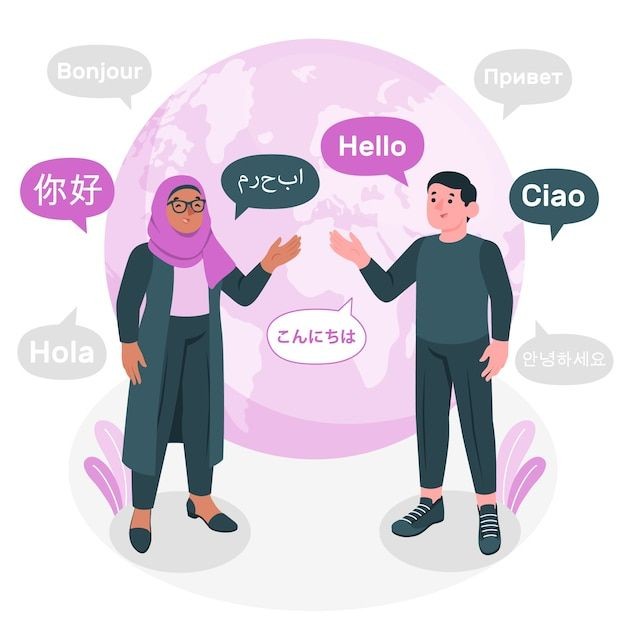
The Impact of Language on the Internet
1. The Evolution of Language in the Digital Age
The idea behind ICQ communication was to model it after the way people speak in face-to-face conversation. In a group of people, conversation is very fast-paced and often hard to follow, and there are many different conversations going on between different sets of people. Trying to capture the nature of such an experience through text, many people began to write messages that consisted of little more than a few words. This is even more prevalent in today’s world, dominated by SMS and mobile technologies. Due to the slow speed of mobile phone keypads, it has become more and more common for people to use abbreviations and acronyms in their messages in order to convey information to the recipient as quickly as possible, and as a result, these have found their way into online communication as well.
In order to examine the evolution of online language, it’s important to look at all of the many ways in which it has changed and developed. Since people first began to communicate through the internet, language has taken on many forms, including email, ICQ, and websites. The most encapsulating, however, have been chat rooms and instant messaging. When chat was first introduced, it was a very static form of communication. People were used to speaking in well-constructed, complete sentences and using correct grammar. All of that changed, however, with the introduction of hasty, ‘instantaneous’ forms of communication, such as ICQ and instant messaging, and it changed even more in recent years due to the widespread use of mobile phones and SMS technology. In ICQ, in particular, people were encouraged to write short, incomplete sentences quickly, in order to keep up with the flow of conversation.
2. Language Barriers and Global Communication
The internet has revolutionized many forms of communication. For those of us who grew up with it, it seems second nature, but for older generations, it’s still somewhat of a novelty. Electronic messaging has been around since the telegraph, but computer-mediated communication is new. Consider this for a moment: a few decades ago, the closest thing to email or an online chat was writing a letter and asking for a reply, yet now in 2008, instant messaging and text-based conversations have become an integral part of daily life. The internet is now understood as a tool for global communication, a space comprised of many ‘communities’, including those comprised by family units, friends, or members of a specific group with similar interests or backgrounds. Despite this, it is important to consider the impact of internet technology on global communication. The effects of the internet on global communication are manifold. In discussing this topic, this paper will focus on the internet’s role in changing the way in which we communicate, the issue of language barriers, and how the internet has affected the maintenance of culture. This first entry will consider computer-mediated communication in comparison to more traditional forms of communication.
3. Linguistic Diversity and Online Communities
In contrast to this positive result, the increased connections between global Internet communities can have negative consequences for users of minority languages in some cases. An example of this is the correlation of increased English language skill and decreased Welsh language skill in young Welsh people, attributed to the influence of English on the culture of the Internet. This creates a complex sociolinguistic situation where speakers of minority languages can be at once empowered and enfeebled by the presence of the Internet in their own language.
The impact that such linguistic diversity has on group formation and socialization on the Internet is complex. It is generally agreed that one of the most prominent forces driving the use of minority languages on the Internet is the desire to escape the ubiquitous English language and find a more private space for communication. This pattern has been observed in studies of groups of World of Warcraft players, who report choosing servers based on their friendliness for speakers of a specific language, fostering an environment where said language is commonly spoken, and on occasion even restricting their own language use to avoid recruitment by players from other linguistic backgrounds.
At the present time, the most rapid growth of language diversity occurs in an entirely different situation. After English, Japanese, German, and Dutch, the fastest growing languages on the Internet are those such as Swedish, Norwegian, and Finnish, whose speakers can read content in the more commonly used German and English, but who often create their own information only in their less commonly used mother tongue. It is generally agreed that the increasing digitalization of minority languages is in itself beneficial and can be used to help ensure the continuation of such languages. An example of this can be found in a recent and controversial decision by the Swedish government to utilize government funding to operate a network of online support entirely in Swedish, intended to reduce the amount of required English language skill for Swedish entrepreneurs.
4. Language Localization in Web Content
Today, the customary way for localizing website content and implementing world-class websites is to use some level of the i18n and L10n approaches and ameliorations are to be expected in future HTML specifications.
In the 1990s, one of the first functions of companies going global was to create multiple language websites. At first, these companies basically replicated their English language web page and translated the textual content using an HTML editor. As the amount and complexity of web website content developed, simple replication no longer was such a viable option. Developers realized that there was a need to create functionality to allow for more efficient localization of both the code and the content. This meant separating content from code, and implementing mechanisms to enable content to be selectively related to specific locales. The HTML+T enthusiasts applied the use of the local attribute on all HTML parts. However, this technique soon proved to be too tedious and a fallback to server-side content negotiation was preferred, where the locale is determined by the T component of an HTTP content-sensibly negotiation.
Internationalization refers to the method of making a software package (in our case, a website) capable of being tailored for different languages and areas. Localization, on the other hand, refers to the method of adapting a globalized software package for a specific region or language by adding locale-specific parts and translating textual content. The core difference between the two is that internationalization is a from side to side procedure, while localization is an upward procedure. As a result, localized tool accommodates an internationalization framework, which allows for additional localizations.
5. Language Technologies and the Future of the Internet.
Following this rapid progression of language technologies, it is pertinent to ask what the future holds for language and the internet. There are many ways in which language technologies are to affect the future of the internet. These include web search, gisting, multilingual technologies, information extraction, summarization, and generation. The future will involve information systems that understand and provide information in conversational language. This ‘question-answering’ will employ techniques in automatic summarization to read vast amounts of texts to return an answer to the user. This system will be multilingual; it will enable access to information across language boundaries. In the realm of machine translation, language technologies will enable the automatic generation of one’s summarized points to be translated and reinserted for the user to construct responses with guidance from the original author. Automatic interpretation is to help facilitate global business, but the system will not be complete until we can accurately translate the ambiguities of one language to another. These technologies are the future of language processing on the internet, but the symbol of all these is gisting. This is the ability to extract an idea from one language and put it into action in another. It is interlingual transfer at its best. All these technologies demand much development of automatic language processing. At the moment, rule-based systems are not capable of this, and it demands much statistical-based research. Step by step, language technologies are to bring these dreams into reality.
This is but one side of future language processing on the internet. The proliferation of mobile internet technologies means that spoken language processing is to be much more prevalent than it has in the past. People will want to use their mobile devices to access information in a hands-free mode. They will demand information systems to give them spoken answers. Such development will merge information systems and automatic dialogue systems to provide spoken language information access in dialogue form.