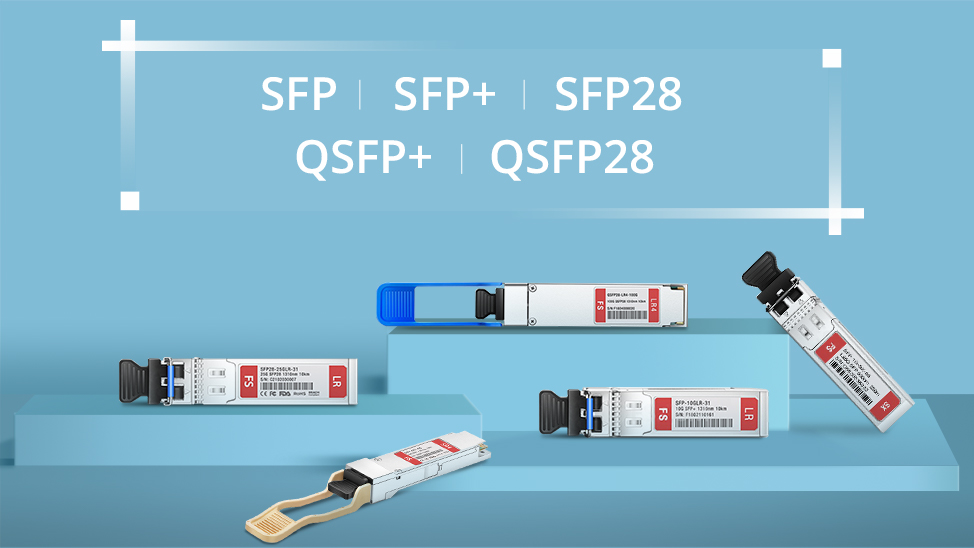
In the ever-evolving landscape of data communication, the demand for higher bandwidth and faster data transfer rates continues to grow. This is driven by the increasing number of devices, data-intensive applications, and the exponential growth of data traffic in data centers and telecommunications networks. Two technologies that have become crucial in meeting these demands are QSFP28 (Quad Small Form-factor Pluggable 28) and SFP28 (Small Form-factor Pluggable 28). Both are transceiver standards designed to support high-speed data transmission, but they cater to different needs and scenarios. This article explores the features, applications, and advantages of QSFP28 and SFP28, providing a comprehensive comparison to help understand their roles in modern networking.es
Understanding QSFP28
Definition and Characteristics
QSFP28 is an optical transceiver standard used for high-speed data communication. It is part of the QSFP family and is designed to support 100 Gigabit Ethernet (100GbE) networks. The “28” in QSFP28 signifies the capability to handle data rates of 28 Gbps per channel, making it a suitable choice for 100GbE, as it typically uses four channels, each running at 25 Gbps or 28 Gbps, to deliver a total throughput of 100 Gbps.
QSFP28 modules are known for their compact size and high density, which allows for significant space and power savings in data centers. They are hot-swappable, meaning they can be installed and removed without powering down the system, which is crucial for maintaining uptime in critical environments.
Applications and Use Cases
QSFP28 transceivers are widely used in data centers, cloud computing networks, and service provider environments. They are ideal for interconnecting network equipment such as switches, routers, and servers that require high-bandwidth, low-latency connections. The use of QSFP28 in data centers facilitates the aggregation of multiple 25GbE or 10GbE connections, enhancing the scalability and flexibility of the network infrastructure.
Common applications include:
- Data center interconnects
- High-performance computing (HPC)
- Cloud networking
- Storage area networks (SANs)
Advantages and Limitations
One of the main advantages of QSFP28 is its high port density, which allows for the efficient use of rack space in data centers. Additionally, QSFP28 modules support a wide range of media types, including copper cables, active optical cables (AOCs), and various types of optical fibers, making them versatile for different deployment scenarios.
However, QSFP28 modules are generally more expensive than lower-speed alternatives like SFP28, and they require more power. The higher cost and power consumption can be a limiting factor for organizations with budget constraints or energy efficiency goals.
Exploring SFP28
Definition and Characteristics
SFP28 is an enhanced version of the SFP+ (Small Form-factor Pluggable Plus) transceiver, designed to support data rates of up to 28 Gbps. While SFP+ supports 10 Gigabit Ethernet (10GbE), SFP28 is intended for 25 Gigabit Ethernet (25GbE) applications, offering a straightforward upgrade path for networks looking to increase their bandwidth without significantly altering their infrastructure.
SFP28 transceivers are also hot-swappable and compact, which makes them a popular choice for a wide range of networking equipment. They are compatible with SFP+ ports, providing backward compatibility and making it easier for organizations to transition to higher speeds.
Applications and Use Cases
SFP28 transceivers are commonly used in data centers, enterprise networks, and telecommunication infrastructures. They are particularly well-suited for edge and aggregation layers in network architectures, where 25GbE provides a balanced solution for both cost and performance.
Typical applications include:
- Access and aggregation layers in data centers
- Enterprise networking
- 5G backhaul and fronthaul networks
- Cloud services
Advantages and Limitations
The primary advantage of SFP28 is its cost-effectiveness compared to QSFP28. It offers a lower cost per port while still providing a significant upgrade over 10GbE. This makes SFP28 an attractive option for organizations looking to increase their network capacity without a major investment.
However, SFP28 does not offer the same level of bandwidth aggregation as QSFP28, which can be a limitation for data centers or networks requiring extremely high data throughput. Additionally, while SFP28 transceivers are backward compatible with SFP+ ports, they do not achieve the full 25GbE speed on those older ports.
Comparison: QSFP28 vs. SFP28
Key Differences
The primary difference between QSFP28 and SFP28 lies in their data throughput capabilities and intended use cases. QSFP28 is designed for 100GbE, offering higher aggregate bandwidth, while SFP28 is designed for 25GbE. This makes QSFP28 suitable for core and spine layers in data centers, where maximum throughput is critical, while SFP28 is better suited for edge and access layers.
Performance Considerations
When choosing between QSFP28 and SFP28, it’s essential to consider the specific performance requirements of the application. QSFP28 modules provide higher density and bandwidth, making them ideal for scenarios where space and power efficiency are crucial. In contrast, SFP28 offers a cost-effective solution for upgrading from 10GbE to 25GbE, providing a balance between performance and budget.
Suitability for Different Environments
QSFP28 is typically used in high-performance environments like data centers, cloud services, and telecommunications networks that require robust and scalable solutions. SFP28, on the other hand, is often deployed in enterprise networks, smaller data centers, and access networks where cost and simplicity are more critical considerations.
Conclusion
Both QSFP28 and SFP28 are essential technologies in the landscape of modern networking, offering distinct advantages for different use cases. QSFP28 provides high bandwidth and density, making it ideal for large-scale data centers and service providers, while SFP28 offers a cost-effective upgrade path for networks transitioning from 10GbE to 25GbE. Understanding the differences between these two technologies allows network architects and engineers to make informed decisions, optimizing network performance and efficiency according to their specific needs.